


 2026-03-16 08:45:47
 1269
1269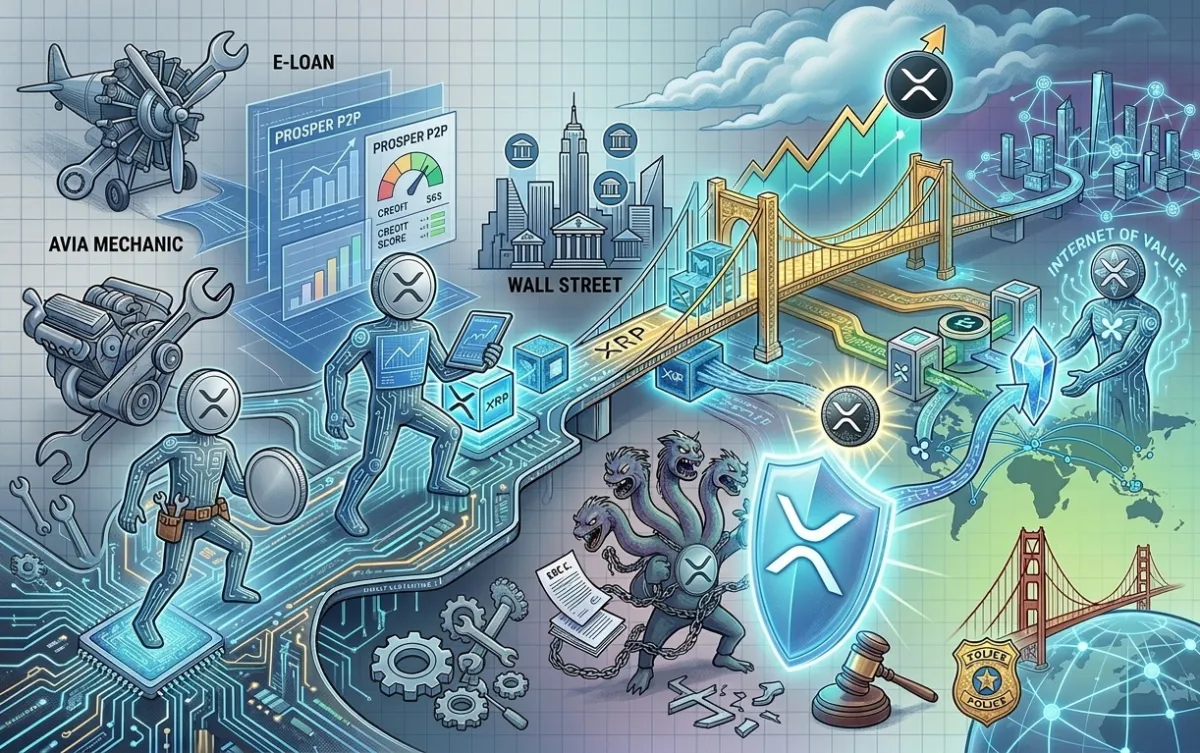
- Silicon Valley Veteran (Life Before Ripple)
- The Birth of Ripple and the XRP Era (2012–2020)
- The Main Battle — Larsen vs. the SEC (2020–2023)
- Larsen's Wealth — How XRP Made Him One of the Richest People in Crypto
- The Face of the Crypto Industry in Politics and Society
- Conclusion: The Legacy of a Bridge Builder
Silicon Valley Veteran (Life Before Ripple)
Most crypto investors today know Chris Larsen as the man behind the XRP Ledger. However, for Silicon Valley, he is a "serial disruptor" who began challenging the foundations of traditional banking back when the internet still came with dial-up static.
From Aircraft Mechanic to Strategist: Roots of Innovation
Chris Larsen was born into a family that blended technical precision with an artistic worldview: his father was an aircraft mechanic, and his mother was an artist. This fusion of discipline and creativity shaped his unique approach to business. He gained his initial experience not within the walls of investment banks, but through direct engagement with the real economy, which later allowed him to view financial processes as engineering systems in need of optimization.
Unlike many of the Valley's "tech geeks," Larsen never positioned himself as a lone coder. He is a classic strategist and "bridge builder," whose main superpower lies in his ability to connect conservative financial institutions with groundbreaking technologies.
The First Revolution: E-Loan and the Battle for Transparency (1997)
In 1997, when banks considered the internet a mere expensive toy, Larsen launched E-Loan — one of the first online lenders in the U.S. This wasn't just a "website with application forms." It was a direct challenge to the banking monopoly on information.
Larsen's main achievement during this period was dismantling the "secrecy" surrounding credit scores.
-
Before E-Loan, banks concealed personal FICO scores from clients, using them as leverage when setting interest rates.
-
Larsen made these scores transparent for all users of the system, effectively "undermining" a long-standing closed practice of banks.
This move laid the foundation for his personal philosophy: the financial system should be open, and information should be accessible.
The Second Revolution: Prosper Marketplace and the Birth of P2P (2005)
After the success of E-Loan, Larsen didn't stop and in 2005 launched Prosper Marketplace — the first P2P lending platform in the U.S.
The idea was radical for its time:
-
Why do you need an intermediary bank if one person can lend money directly to another?
-
Prosper became a prototype of what we now call decentralized finance (DeFi), long before Ethereum smart contracts existed.
This experience revealed to Larsen the main problem of the global economy: money moves too slowly. Information circles the globe in milliseconds, yet a bank transfer between countries in the 2010s still took 3–5 business days.
Formulating the Idea of the "Internet of Value"
Two decades at the forefront of fintech led Larsen to a global conclusion: the world needs new infrastructure. He formulated the concept of the "Internet of Value" (IoV) — a network where value (money, stocks, intellectual property rights) can be transferred as easily and instantly as data on the regular internet.
It was this vision that, in 2012, brought him together with Jed McCaleb and Arthur Britto, leading to the creation of the company we now know as Ripple. Larsen didn't join for quick money — he came to complete the architecture of the global financial system, a reform he had begun in the late nineties.
The Birth of Ripple and the XRP Era (2012–2020)
If the first half of Larsen's career was dedicated to trying to "tweak" the banking system, the second half became an ambitious attempt to rebuild it entirely. In 2012, Chris Larsen teamed up with Jed McCaleb and Arthur Britto to launch a project called OpenCoin, which soon transformed into Ripple.
The Founder's Conflict: A Clash of Ideologies
Ripple's history began not with harmony, but with a fundamental split. Chris Larsen and Jed McCaleb (creator of eDonkey and the Mt. Gox exchange) represented two different universes.
-
Jed McCaleb strived for maximum decentralization and open-source code, following the cypherpunk spirit.
-
Chris Larsen, being an experienced strategist, insisted on a pragmatic approach: for the technology to work, it must be understandable and convenient for traditional financial institutions.
This conflict led to McCaleb's departure in 2013, which began a multi-year drama involving massive XRP sales ("dumps") by Jed. Larsen, however, remained at the helm, solidifying his role as the "bridge builder" between the world of crypto-anarchy and Wall Street.
XRP Ledger: Money at the Speed of Thought
Unlike Bitcoin, which was created as an alternative to gold, or Ethereum, which became the world computer, XRP was initially designed as a "bridge currency" for banks.
-
Technical Specifications: The XRP Ledger can process up to 1500 transactions per second with fees of a fraction of a cent.
-
Mechanics: Upon launch in 2012, 100 billion tokens were created, of which 80 billion were given to Ripple to develop the ecosystem.
January 2018: The Richest Man Nobody Had Heard Of
The peak of Larsen's fame and wealth came in January 2018. Amid the crypto market's insane rally, the XRP price reached $3.84.
-
The Numbers: Larsen's personal assets and his stake in the company were theoretically valued at $59 billion.
-
Status: For a few weeks, he became the fifth richest person on the planet, officially surpassing Mark Zuckerberg on the Forbes list.
However, Larsen himself always emphasized that this wealth was "paper wealth." The XRP market at that time lacked sufficient liquidity for him to cash out even a small fraction of that amount without crashing the price. It was a triumph of vision, but also a massive target he had inadvertently painted on his company's back.
Ripple in 2025–2026: An Institutional-Scale Machine
By early 2026, Ripple had transformed from a startup into a global financial giant. Despite years of legal battles, the company achieved a valuation of $50 billion after raising $500 million in November 2025 from heavyweights like Citadel and Fortress.
Today, Ripple's product line, under Larsen's guidance (as Chairman of the Board), covers all aspects of digital finance:
-
Ripple Payments: A next-generation international payments system.
-
Custody: Professional digital asset storage.
-
RLUSD: The company's own stablecoin, serving as a bridge between fiat and crypto.
-
Ripple Prime: A platform for institutional trading and liquidity.
Currently, XRP is used in over 100 institutional partnerships worldwide, confirming Larsen's long-term strategy — to change the system from within, rather than trying to destroy it.
The Main Battle — Larsen vs. the SEC (2020–2023)
This is the heart of our story, where dry financial charts give way to real legal drama. If before 2020 Chris Larsen was perceived by the market as a successful visionary, December of that year turned him into public enemy number one for the top U.S. financial regulator.
The December Strike: A Personal Challenge
On December 22, 2020, the U.S. Securities and Exchange Commission (SEC) delivered a devastating blow by filing a lawsuit against Ripple. However, there was a critically important detail in this case: Larsen was personally named as one of the primary wrongdoers.
This fundamentally changed the rules of the game. It wasn't just about corporate fines that the company could pay from its budget. Larsen faced:
-
Full personal liability on charges of violating securities laws.
-
A lifetime ban from serving as an officer or director of public companies.
-
Forced disgorgement of personal funds earned from XRP sales.
The stakes were incredibly high. Realizing that not only his fortune but his entire reputation was on the line, Larsen made an unprecedented decision: he hired his own legal team, separate from Ripple's legal department. This was a survival strategy, requiring colossal resources and a willingness to see it through to the end.
The Turning Point: Judge Torres's Ruling
For three years, the industry lived in the shadow of this legal battle. The denouement began in July 2023 when Judge Analisa Torres issued a historic ruling that divided XRP sales into two categories: programmatic and institutional.
-
The court recognized that sales of XRP to ordinary investors through exchanges (programmatic sales) do not constitute securities transactions.
-
This was the first major crack in the SEC's armor, which had spent years trying to prove the opposite.
October 2023: The Regulator's Capitulation
The final chord sounded in October 2023, when an event shocked the legal community: the SEC unexpectedly and completely dropped all charges against Chris Larsen and Brad Garlinghouse.
Analysts still debate the reasons for this "retreat." The main theory is that the regulator simply didn't dare to take the case to a jury trial. The risk of a public loss in front of ordinary citizens, who might side with an innovative entrepreneur, was too great.
For Larsen, this was a complete victory and final vindication of his strategy of openness. He didn't just preserve his assets — he proved that even one person can successfully stand up to the state machinery if they have technological truth on their side.
Larsen's Wealth — How XRP Made Him One of the Richest People in Crypto
Having passed through the crucible of the courts, Larsen emerged not only vindicated but significantly wealthier. His financial portfolio today is a complex structure, inextricably linked to the success of the ecosystem he helped build.
Financial Profile (2025–2026 Data)
Currently, Larsen's primary capital consists of two powerful pillars:
-
Stake in the Company: He owns approximately 18% of Ripple shares. Given the company's $50 billion valuation, this asset alone is worth billions.
-
Personal Tokens: According to on-chain analytics for 2025–2026, his personal holdings range from 2.5 to 2.7 billion XRP.
At peak moments in 2025, when the XRP price fluctuated between $2.22 and $3.60, Larsen's personal fortune exceeded $15.3 billion. Currently, according to 2026 Forbes data, it has stabilized around $12.4–13.1 billion, placing him 245th on the list of the world's richest people. Additionally, about $1.8 billion is distributed between prime real estate and other investments, including the philanthropic Rippleworks Foundation.
Controversy: "Dumps" or Investments?
The hottest topic in the XRP community is the large transfers of funds from Larsen's wallets, which critics were quick to label "token dumps."
-
In July 2025, 50 million XRP (~$175 million) were moved, causing a brief 14% price drop.
-
In October 2025, another 50 million XRP were directed into the Evernorth project (a Ripple-backed SPAC).
While retail investors accused him of manipulation, Larsen and his representatives provided a clear explanation: these are not sales "into the market," but strategic investments in ecosystem development, such as the Evernorth and Yellow Network projects. Despite these movements, his holdings remain colossal, securing his status as one of the largest "whales" in cryptocurrency history.
The Face of the Crypto Industry in Politics and Society
Chris Larsen has long outgrown the status of a mere executive or shareholder. Today, he is one of the most influential and, arguably, most controversial public figures in the global tech elite. His activities outside Ripple's San Francisco headquarters vividly demonstrate how new-generation capital seeks to transform not only financial protocols but also the social fabric of society.
Political Heavyweight: Betting on Progress
In 2024, Larsen definitively cemented his status as the largest donor from the entire cryptocurrency industry. His political investments exceeded $11.8 million, with the majority directed toward supporting Kamala Harris's campaign.
For many in the crypto community, which traditionally leans libertarian or Republican, such support for Democrats seems paradoxical. However, Larsen's logic is based on a long-term calculation:
-
Fair Regulation: He believes that technological progress is impossible without clear but fair rules of the game, which Democrats might be better positioned to provide.
-
Technological Leadership: Supporting the administration is a way to ensure the U.S. remains the hub of fintech innovation, rather than pushing it offshore.
-
Bipartisan Balance: Despite his leanings toward Democrats, Larsen maintains pragmatism and often demonstrates a bipartisan approach, supporting candidates from different camps if their platform promotes innovation.
The San Francisco Paradox: The Crypto Billionaire and the Police
The most discussed and controversial aspect of Larsen's public activity has been his role as a "guardian angel" for his native San Francisco. In a city gripped by crises of crime and homelessness, Larsen chose a path that many found unexpected for a Silicon Valley native.
While other tech leaders relocate to Texas or Miami, Larsen invests in public safety:
-
Technological Leap: In 2025, he made a monumental gift to the San Francisco Police Department (SFPD) of $10 million to create a modern technology hub.
-
Systemic Support: He personally founded the San Francisco Police Community Foundation, contributing an initial $1 million.
-
Social Responsibility: His philanthropy isn't limited to law enforcement; during the COVID-19 pandemic, he directed significant funds to food banks, helping the most vulnerable populations.
His motivation is simple yet profound: Larsen wants to solve the problems of homelessness and crime in his hometown using the same principles of efficiency he implemented in business. He believes that safety is a fundamental condition for any kind of prosperity.
Conclusion: The Legacy of a Bridge Builder
Summing up this extensive retrospective, we see not just the biography of a billionaire, but the story of the evolution of financial ambition. Chris Larsen has journeyed from an aircraft mechanic dreaming of transparent credit scores to the architect of a global system where money moves at the speed of light.
On the threshold of the mid-2020s, Larsen remains a key figure balancing two worlds. His $13 billion fortune is not just personal success, but also fuel for his large-scale social and political experiments.
He is a man who did not shy away from open battle with the SEC and emerged victorious, remaining true to his vision of the "Internet of Value." And while crypto enthusiasts continue to debate XRP "dumps" and centralization, Larsen continues to build his "bridges," confident that the future belongs to those who can negotiate with the system while simultaneously changing it from within.