


 2026-02-26 18:56:05
 1272
1272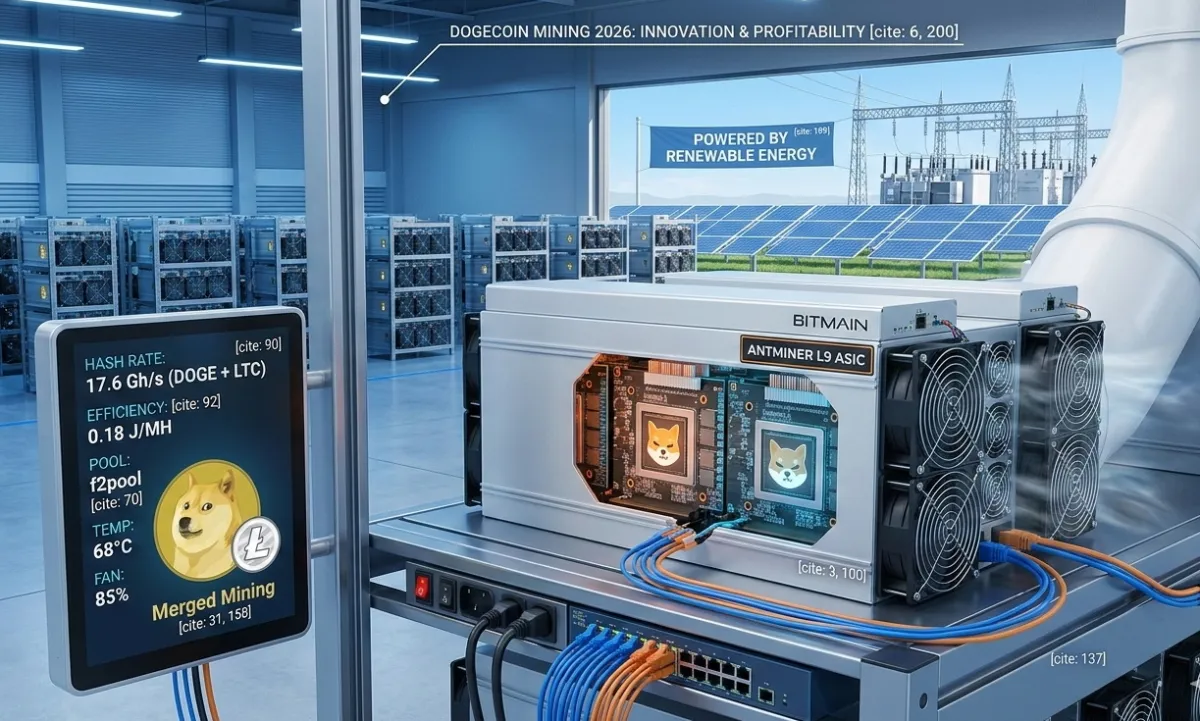
- Introduction: Is Dogecoin Mining Realistic Today?
- Technical Foundation: How the Dogecoin Network Works
- Merged Mining: The Secret Weapon of a Dogecoin Miner
- Choosing a Mining Strategy
- Hardware: What to Buy in 2026?
- Software and Configuration
- Step-by-Step Guide: From Box to First Coin
- Economics and Profitability Calculation (ROI)
- Risks, Legality, and Best Practices
- Conclusion: Is It Worth Starting in 2026?
1. Introduction: Is Dogecoin Mining Realistic Today?
Dogecoin's Role in the Modern Financial System
Dogecoin (DOGE) has evolved from a cultural phenomenon and internet meme into one of the most significant digital assets. In 2026, the coin consistently holds a position in the top ten cryptocurrencies by market capitalization. What began as a social experiment has transformed into a reliable decentralized network, supported by a massive community and major technological investors.
The Relevance of Mining in 2026
The main question facing any potential network participant is whether it's worthwhile to invest in mining equipment or more effective to simply purchase the asset on an exchange.
-
Direct Purchase provides immediate access to the asset but exposes the investor to the risks of high price volatility.
-
Mining represents a form of long-term investment in infrastructure. With access to competitive electricity rates, mining allows you to acquire coins at a cost that is often below the market price, while also providing a steady stream of liquidity.
Content Overview
In this article, we will systematically break down all stages of working with Dogecoin. You will learn about the network's technical structure, the principles of merged mining with Litecoin, how to choose current hardware, and methods for calculating return on investment.
2. Technical Foundation: How the Dogecoin Network Works
The Scrypt Algorithm and Its Features
At the core of Dogecoin lies the Scrypt hashing algorithm. This is a key distinction from Bitcoin, which uses the SHA-256 algorithm.
The main feature of Scrypt is its demand for a device's RAM, not just its raw processing power. Initially, this was designed to protect the network from monopolization by large farms and keep it accessible to regular users. However, over time, technological progress led to the creation of specialized devices — ASIC miners — optimized specifically for this algorithm.
Block Generation Mechanics and Rewards
The Dogecoin network is designed to ensure high transaction speed:
-
Block Time: A new block is created on average every 60 seconds. This is 10 times faster than the Bitcoin network, making Dogecoin a convenient medium of exchange.
-
Miner Reward: For each successfully found block, the system pays a fixed reward of 10,000 DOGE.
-
Emission Model: Unlike many cryptocurrencies with a limited supply, Dogecoin has a fixed annual inflation rate. Approximately 5.2 billion new coins enter the network each year. This model encourages using the currency for payments rather than just hoarding, and guarantees continuous compensation for miners even in the distant future.
Evolution and Implementation of Merged Mining (AuxPoW)
The history of Dogecoin's development includes several important stages that shaped its current stability:
-
Launch (2013): The coin was created as a fork of the Luckycoin project, which itself was based on Litecoin.
-
Transition to Merged Mining (2014): A pivotal event in the coin's history — the adoption of Auxiliary Proof-of-Work (AuxPoW) technology. This allowed miners to mine both Litecoin and Dogecoin simultaneously, using the same computational power. This decision dramatically increased the security of the Dogecoin network, making it resilient to external attacks due to the immense hashrate of the Litecoin network.
-
Current State (2026): Today, the network is characterized by all-time highs in difficulty. Mining on central processing units (CPUs) and graphics cards (GPUs) has completely lost its economic viability, giving way to industrial-scale setups.
3. Merged Mining: The Secret Weapon of a Dogecoin Miner
What is Merged Mining?
Merged Mining is a technology that allows you to mine two different cryptocurrencies simultaneously, using the same computational power. In the Dogecoin and Litecoin pairing, it works like this: the miner directs their resources to solve problems on the Litecoin network (the parent chain), but the results of this work are also accepted by the Dogecoin network (the auxiliary chain). The device's performance is not split between the coins — you get 100% power for each.
How AuxPoW (Auxiliary Proof of Work) Works
Technically, this process is called Auxiliary Proof of Work. To put it simply, the Dogecoin blockchain trusts the proof of work done for the Litecoin blockchain. When a miner finds a solution for a Litecoin block, they attach Dogecoin transaction data to it. The Dogecoin network verifies this solution, and if it meets the difficulty criteria, it accepts the block as valid. Thus, the work is done once, but the reward is paid in two different assets.
Why Is This Critical in 2026?
In the current environment of high competition and electricity costs, mining only a single Scrypt-based coin often becomes economically unviable. Merged Mining offers two key advantages:
-
Increased Profitability: The miner receives rewards in both LTC and DOGE. In 2026, this is often the only way to achieve a fast return on investment for your equipment.
-
Network Security: Thanks to this technology, Dogecoin leverages the enormous hashrate of the Litecoin network, making it practically immune to 51% attacks.
Statistics and Adoption
Currently, over 95% of all Dogecoin blocks are mined through merged mining. This means that almost all major pools and industrial farms operate using this method. Ignoring this mechanism in 2026 deprives a miner of a significant portion of their potential profit.
4. Choosing a Mining Strategy
Before purchasing equipment, you need to decide on your participation format. There are three main approaches, each with its own risks and entry barriers.
Solo Mining
This method involves working alone, trying to find a block independently without sharing power with others.
-
Pros: If successful, you receive the entire reward (10,000 DOGE + the LTC block reward). You don't have to pay pool fees.
-
Cons: Due to the extremely high network difficulty in 2026, the probability of finding a block with just one or even ten devices is minuscule. It's like a lottery where a win might not happen for years.
-
Who it's for: Only owners of massive data centers (gigawatt-scale farms) whose combined hashrate is comparable to a share of the global market.
Mining Pools (Collective Mining)
A pool is a server that combines the power of thousands of miners to search for blocks collectively. The reward is distributed among participants proportionally to their contribution.
-
How it works: The pool finds blocks much more frequently than a solo miner, ensuring stable and predictable income.
-
Top 5 Pools in 2026:
f2pool: One of the oldest pools, supporting Merged Mining and offering a convenient mobile app.
ViaBTC: Popular for its transparent payment system and integrated coin exchange service.
Binance Pool: Convenient for those who want payouts directly to their exchange account.
LitecoinPool: A specialized, reliable pool with zero fees on some payout types.
AntPool: A large pool from equipment manufacturer Bitmain, offering high stability.
How to Choose a Pool: Pay attention to the fee (usually 1-4%), ping to servers (lower ping means less latency/lost shares), and the minimum payout threshold. It's also important to understand the reward distribution system: PPS (fixed payment for each share submitted) or PPLNS (payment based on the number of shares submitted during the rounds when the pool finds a block).
Cloud Mining (Renting Hashrate)
The concept involves paying a company to rent the computational power of their equipment.
-
Reality in 2026: Unfortunately, the cloud mining market is saturated with fraudulent projects. Most offers are essentially Ponzi schemes that don't own real equipment.
-
Economic Viability: Even legitimate services (like NiceHash or Genesis Mining) often set rates that, upon calculation, turn out to be less profitable than simply buying coins on an exchange.
-
Recommendation: If you decide to use this method, thoroughly research the company's legal standing and only use trusted marketplace platforms like NiceHash, where you buy hashrate from real users rather than from an "abstract" data center.
5. Hardware: What to Buy in 2026?
The Era of ASIC Dominance
In 2026, the question of mining Dogecoin on GPUs or CPUs is definitively settled. The reason is the colossal gap in energy efficiency. Specialized devices, called ASIC miners (Application-Specific Integrated Circuit), perform Scrypt algorithm calculations thousands of times more efficiently than any consumer computer. Attempting to mine with a graphics card today will only lead to equipment wear and electricity bills that far exceed any income.
Top ASIC Miners for Scrypt (2025-2026)
The hardware market in 2026 is dominated by several key players whose devices define the industry's profitability.
-
Bitmain Antminer L9 (17.6 Gh/s): The undisputed flagship. This device boasts the best energy efficiency rating — around 0.18 J/MH. Consuming 3260W, it delivers a record hashrate. Due to its high noise level (around 75-80 dB), it can only be operated in specially prepared, non-residential spaces.
-
ElphaPex DG1+ (15.4 Gh/s): The main competitor to Bitmain's products. This model is valued for its operational stability and quality cooling system. Although its performance is slightly below the flagship, many choose it for its more accessible price and reliable component base.
-
Bitmain Antminer L7 (9.5 Gh/s): The "workhorse" of previous years. Despite newer models being released, the L7 remains relevant on the secondary market. It's an excellent option for those with access to cheap electricity, as the device's price in 2026 has dropped significantly.
-
Goldshell Mini-DOGE Pro (2.3 Gh/s): A solution for home environments. This miner operates quietly, consumes only about 450-500W, and can be plugged into a standard household outlet. It won't generate huge profits but is ideal for learning the technology and supporting the network.
Model Comparison Table (Estimated Data for 2026)
| Model | Hashrate | Power Consumption | Efficiency | Approximate Price |
|---|---|---|---|---|
| Antminer L9 | 17.6 Gh/s | 3260 W | 0.18 J/MH | $8,500 – $10,500 |
| ElphaPex DG1+ | 15.4 Gh/s | 3100 W | 0.20 J/MH | $7,000 – $8,500 |
| Antminer L7 | 9.5 Gh/s | 3425 W | 0.36 J/MH | $3,500 – $4,500 |
| Mini-DOGE Pro | 2.3 Gh/s | 450 W | 0.21 J/MH | $800 – $1,200 |
Mining on Smartphones and PCs: Debunking Myths
You can often find ads for apps claiming to "mine DOGE on Android." It's crucial to understand: real mining on smartphones is impossible. What you see in such apps is either a simulation of the process or watching ads for tiny fractions of coins. The same applies to laptops: even a powerful gaming PC will generate a monthly income that doesn't even cover a cup of coffee, while the risk of overheating and damaging the device is extremely high.
6. Software and Configuration
Choosing Firmware for Your ASIC
Each device comes with pre-installed software from the manufacturer (stock). However, experienced miners often use third-party firmware (e.g., Vnish or Hiveon).
-
Why do this? Third-party software allows for "fine-tuning" each hash board. You can overclock the device (increase profitability) or under-volt it (reduce power consumption if electricity prices are high).
Monitoring and Management Tools
If you have more than one device, managing them manually becomes cumbersome. Monitoring systems are used for this:
-
HiveOS (ASIC Hub): The industry standard. It allows you to see the status of all your miners, their temperature, and hashrate via a browser or app. If a device stops working, the system will send a notification via Telegram.
-
Awesome Miner: A powerful Windows-based tool, especially useful for large farms where automation of switching between pools is needed.
Wallets for Receiving Payouts
Your earned coins need to be stored somewhere. The choice depends on your goals:
-
Hot Wallets (for active use):
-
Dogecoin Core: The official client. It makes your computer part of the network (a full node) but requires significant disk space and time for initial synchronization.
-
Trust Wallet / Exodus: Convenient mobile applications.
-
Exchange Wallets: Convenient for quick selling, but remember: as long as your keys are held on the exchange, the coins technically aren't yours.
-
Cold Wallets (for long-term storage):
-
Ledger or Trezor: Hardware devices that look like USB drives. This is the safest storage method. Even if your computer is infected with a virus, thieves cannot steal your coins without physical confirmation on the device.
Critically Important: When creating any wallet, you will be given a seed phrase (12 or 24 words). Never store it digitally (screenshots, notes). Write it down on paper and keep it in a secure place. Losing this phrase means the irreversible loss of all your Dogecoin.
7. Step-by-Step Guide: From Box to First Coin
Setting up an ASIC miner is a process that requires attention to detail. A mistake during preparation can lead to costly equipment failure.
Step 1. Infrastructure and Safety
Before unboxing the device, prepare its operating environment:
-
Electrical System: A modern flagship (like the L9) consumes over 3 kW. This is comparable to running two powerful electric kettles simultaneously. Ensure your wiring can handle this load 24/7. For farms with multiple devices, a 380V supply is highly recommended.
-
Ventilation: ASICs generate a tremendous amount of heat. You will need either powerful intake/exhaust ventilation or immersion cooling (submerging the units in a special dielectric fluid).
-
Soundproofing: The noise level of an industrial miner is comparable to a running vacuum cleaner. Operation in residential areas is only possible using specialized soundproofing enclosures ("noise boxes").
-
Fire Safety: Use only high-quality power cables with the appropriate gauge and consider installing automatic fire suppression systems.
Step 2. Create a Wallet
Set up the address where your payouts will be sent. As discussed, Trust Wallet is suitable for beginners, while hardware wallets like Ledger or Trezor are for serious amounts. Be sure to write down the 12-24 word seed phrase on paper and store it securely, like in a safe.
Step 3. Connect the Hardware
-
Unbox the ASIC and inspect it for any shipping damage.
-
Connect the Ethernet cable. Using Wi-Fi via adapters is strongly discouraged due to signal latency (ping), which leads to lost profits.
-
Power on the unit by connecting the power supply.
-
From a computer on the same network, find the miner's IP address (use tools like *Advanced IP Scanner* or the manufacturer's dedicated software).
Step 4. Configure the Pool
Enter the miner's IP address into your browser — you will access the device's web interface. Navigate to the Miner Configuration section and fill in the details:
-
URL: The pool's address (e.g., stratum+tcp://ltc.viabtc.com:3333).
-
Worker: The name for your miner (e.g., your_account_name.001).
-
Password: Usually "x" or "123".
Step 5. Start and Monitor
After saving the settings, the miner will need 10-20 minutes to reach full operational status ("warm up"). Check the pool's website in your personal dashboard to confirm that your worker (device) shows as active. Set up automatic payouts so that coins are transferred to your wallet regularly, such as daily.
8. Economics and Profitability Calculation (ROI)
Mining is a mathematical game. To understand when your equipment will pay for itself, you need to account for more than just the exchange rate; operating expenses are key.
The Formula for Net Profit
In 2026, we calculate income from two coins simultaneously (DOGE + LTC):
Profit = (DOGE Reward + LTC Reward) × Exchange Rate - (Power Consumption × Electricity Tariff) - Pool Fees
Key Influencing Factors
-
Electricity Cost: This is the primary factor. At a rate of $0.04/kWh (common in rural areas or industrial zones), mining is highly profitable. At rates above $0.12/kWh, the payback period can stretch out for years.
-
Network Difficulty: The more people turn on their ASICs, the fewer coins each individual miner receives. In 2026, hashrate is growing rapidly, so factor in a gradual monthly decline in your mining output of around 3-5%.
-
Exchange Rates: DOGE and LTC often move in tandem, but a sharp rise in the "meme" coin's price could potentially cut your equipment's payback period in half.
Useful Tools
For quick calculations, use online calculators like WhatToMine or CoinWarz. Enter your ASIC model, and the service will automatically input the current difficulty and exchange rates to show your estimated daily, weekly, and monthly profitability.
Hidden Costs
Beyond electricity bills, miners often overlook:
-
Depreciation: Equipment becomes obsolete both technologically and physically. After 2-3 years, its resale value will drop significantly.
-
Repairs: Cooling fans are consumable items and tend to fail most often.
-
Fees: Pools take about 1-3%, and exchanges or wallets may charge another ~1% when you cash out to fiat currency.
9. Risks, Legality, and Best Practices
Main Risks for Miners
Even with the most modern equipment, mining carries several factors that can impact your income:
-
Market Volatility: Cryptocurrencies remain high-risk assets. A sharp drop in the price of DOGE or LTC can temporarily make mining unprofitable ("below the cost of electricity"), where electricity costs exceed the value of the coins mined.
-
Technical Challenges: Operating 24/7 leads to component wear. Overheating can cause performance degradation (throttling) or complete failure of expensive chips. Furthermore, the noise from ASIC miners in residential areas is a common source of conflict with neighbors.
-
Security and Scams: In 2026, there has been an increase in phishing incidents (fake pool websites) and the sale of repaired or defective ASICs disguised as new units.
Legal Aspects and Taxes
By 2026, most countries have established clear rules for miners:
-
Regulation: In the US, EU, and several other countries, mining is legal but may require registration upon reaching certain power thresholds. Some regions offer special electricity tariffs for data centers.
-
Taxation: In most jurisdictions, mining is classified as a business activity. This means you are required to declare income either at the moment coins are received in your wallet or when they are sold for fiat currency. It is recommended to keep strict records of equipment and electricity expenses to optimize your tax liability.
Best Practices
To keep mining profitable and secure, follow these professional tips:
-
Sustainability and Savings: Using renewable energy sources (solar panels or excess from small hydroelectric plants) is becoming standard. This is not only ethical but also protects you from increases in state-regulated utility rates.
-
Cybersecurity: Enable two-factor authentication (2FA) on all your pool and exchange accounts. Keep only working capital in "hot" wallets, transferring the bulk of your profits to "cold" storage.
-
Community: For technical issues, seek answers in specialized communities. Platforms like Reddit (r/dogemining, r/litecoinmining) remain excellent sources for up-to-date information on configuration and repairs.
10. Conclusion: Is It Worth Starting in 2026?
Summary
In 2026, Dogecoin mining has ceased to be a hobby for enthusiasts and has transformed into a full-fledged technological business. It is no longer "passive income" in the pure sense — the process requires engineering knowledge, financial planning, and constant market monitoring.
The Main Trend
The market has become professional. Today, only those who leverage the advantages of merged mining (LTC + DOGE), have access to low-cost electricity, and timely update their equipment fleet to energy-efficient models like the Antminer L9 can survive and profit.
An Alternative Path
If you lack the means to properly cool an ASIC or if the electricity cost in your region exceeds $0.10 per kWh, a more rational approach might be to simply buy Dogecoin on an exchange, or to allocate funds to less energy-intensive earning methods, such as staking other assets.
Final Checklist for Beginners
Before purchasing your first miner, check yourself against these five points:
-
Power Capacity: Can your electrical system handle a continuous 3.5 kW load for a single device?
-
Cost Basis: Have you calculated profitability based on your specific electricity tariff and pool fees?
-
Location: Do you have a solution for heat exhaust and noise suppression?
-
Payback Period: Are you prepared for the equipment to potentially take 12 to 18 months to pay for itself?
-
Security: Have you purchased a hardware wallet and securely stored your seed phrase?