


 2026-03-10 11:11:23
 731
731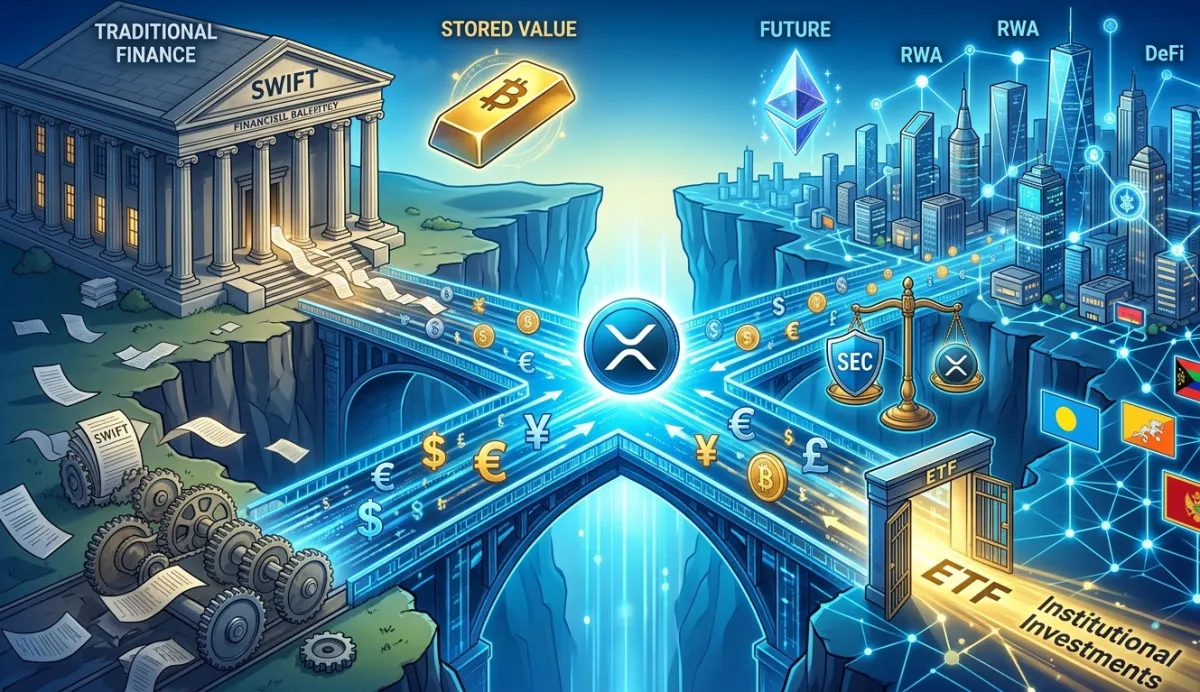
- Ripple: The Cryptocurrency That Put on a Business Suit
- Fundamental Analysis: Why It Works
- Institutional Breakthrough: The End of the "Era of Fear"
- Real-World Use: Where Does Ripple Already Work?
- The Flip Side: What an Investor Must Remember
- How to Invest: A Practical Guide
- Forecasts and Prospects Until 2030
- Place in a Portfolio: What to Compare XRP With?
- Conclusion: Is It Worth It?
1. Ripple: The Cryptocurrency That Put on a Business Suit
If you've ever glanced at cryptocurrency news, you've undoubtedly seen the endless carnival: meme coins with dogs and frogs that skyrocket and crash within hours, or mysterious projects promising to upend the world order. In this noisy amusement park, Ripple looks like a serious financial institution that consciously chose the path of evolution, not revolution. While others shout about the "death of banks," Ripple shakes hands with their directors and offers solutions to problems that haven't changed for decades.
A Bridge Over the Financial Abyss
The main problem with modern money is that it moves around the world slower than a paper letter did in the last century. If you want to send a transfer to a friend in another country, your money goes through a chain of several intermediary banks, loses part of the amount in fees, and arrives at its destination days later. This happens because the global SWIFT system, which underpins it all, was invented back in the 70s and simply hasn't kept pace with the digital age.
Investing in Ripple is not buying "digital trinkets." It's a bet that the old, creaky transfer system will inevitably lose to a new high-speed highway. Ripple is building an "Internet of Value," where money moves as fast and easily as a message in a messenger. We are investing in a real tool that removes bottlenecks from the world's financial circulatory system, competing with the giants of the past.
Status and Reality: Where the Project Stands Now
Today, Ripple is no longer a brash startup but a giant with a multi-billion dollar market cap, firmly established in the top 10 global cryptocurrencies. The market has long stopped perceiving XRP as a tool for quick speculation. It is now a "utility token"—something with fundamental value because it's needed by banks and corporations to operate.
Before going further, it's important to remember one "golden" rule for investors: don't confuse the company and the coin.
-
Ripple Labs — is a private company, a developer of technology and software (a kind of "Apple in the world of finance").
-
XRP — is the digital asset, the token that works on this network.
When you buy XRP, you are buying the "fuel" for the system. If the company's technology becomes in demand by banks, demand for this "fuel" naturally grows.
2. Fundamental Analysis: Why It Works
To understand why millions are invested in XRP, you need to look under the hood. Unlike Bitcoin, Ripple doesn't require huge factories with graphics cards that devour electricity. The system operates on a "consensus" basis—where a group of trusted servers instantly confirms the authenticity of a transfer.
Technology in the Service of Capital
For an investor, Ripple's technology is primarily about impressive numbers that make it competitive:
-
Speed: A transfer is confirmed in 3-5 seconds. Bitcoin can "think" for hours.
-
Scale: The network processes over 1500 transactions per second, comparable to the capacity of the Visa payment system.
-
Negligible Fees: A transaction costs fractions of a cent. A bank can conduct thousands of payments, barely noticing the costs.
-
Ecology: The absence of mining makes XRP a "green" currency. This is critically important for large investment funds, which today are required to comply with environmental (ESG) standards.
Ecosystem of Products: What the Business is Built On
Ripple Labs has created a whole arsenal of tools that generate real, not imaginary, demand for the asset:
-
Ripple Payments: The company's main product. It allows banks not to hold millions of dollars in accounts in different countries "just in case." XRP acts as an instant converter here: your dollars turn into tokens, fly across the ocean, and turn into euros or yen on the other end.
-
RLUSD (Ripple USD): The company's own stablecoin, pegged to the dollar. It adds stability to the system, allowing large players to lock in profits and store funds within the network without the risk of volatility.
-
Custody Services: Ripple helps banks securely store their digital treasures, becoming a reliable technology partner for them.
The Math of Success: How Tokenomics Works
Investors love mathematical certainty, and XRP has it:
-
No Inflation: A total of 100 billion coins were created. New XRP will never be "printed."
-
Escrow System: To prevent the company from suddenly selling all its holdings, most of the coins are locked in a "smart safe." They are released to the market strictly on a schedule in small portions. This creates transparency: the market knows in advance how many coins will enter circulation.
-
Burning Mechanism: A tiny amount of XRP is burned for each transaction on the network. This means the total number of coins in the world slowly but surely decreases. The more people use the network, the scarcer the asset becomes.
Ultimately, XRP acts as a universal "currency bridge." Banks find it advantageous to use for quickly and cheaply exchanging one currency for another. And the more global financial institutions join this network, the higher the value of each coin in an investor's hands.
3. Institutional Breakthrough: The End of the "Era of Fear"
For a long time, a heavy storm cloud hung over Ripple—a lawsuit from the US regulator (SEC). Investors feared the project might simply be shut down and the coin declared an illegal security. But history took an unexpected turn that forever changed the rules of the game.
A Victory That Became Law
The legal battle ended with a historic ruling: the court officially recognized that the XRP coin itself is not a security. It was a moment of truth. The era of uncertainty ended, and the shackles of fear fell from exchanges and large funds. The final fine the company paid in 2025 was merely a small price for a "ticket" into the legal field of the US. Now XRP is one of the few digital assets with a clear legal status, making it extremely attractive to conservative investors.
The Era of XRP-ETFs: Floodgates Open
Following the success of Bitcoin and Ethereum, it was Ripple's turn. The launch of spot exchange-traded funds (ETFs) based on XRP became the "golden bridge" over which Wall Street capital flooded into the ecosystem. Now, large pension funds and insurance companies don't need to understand wallets and keys—they buy XRP through familiar exchange-traded instruments. This provided the asset with a colossal influx of liquidity and finally cemented its status as a "traditional" financial instrument.
Ripple Labs: Who's Behind the Scenes?
While ordinary investors buy coins, the "sharks" of business invest in Ripple Labs itself. Giants like Citadel Securities and Fortress believe in it, and the company's overall valuation has already reached an impressive $50 billion. Talk of the company's IPO (Initial Public Offering) is becoming more frequent. For the average person, this means Ripple is turning into a systemically important corporation, whose success directly pulls up the value of its entire ecosystem.
4. Real-World Use: Where Does Ripple Already Work?
Cryptocurrencies are often criticized for being "detached from reality." But Ripple is a pleasant exception. The project doesn't just promise change; it is already deeply integrated into the global financial system.
Partnerships with Giants
If you live in Japan or Europe, there's a chance your money is already moving using Ripple's technology. Japanese banking giant SBI and European bank Santander actively use the company's solutions for instant settlements. These aren't theoretical tests but daily transactions worth millions of dollars. Banks choose Ripple because it saves them time and money that intermediaries used to consume.
Government Level: Digital Money for Nations
Ripple went even further, becoming a technology partner for entire nations. Countries like Palau, Bhutan, and Montenegro have chosen the Ripple platform to develop their national digital currencies (CBDCs). When governments trust a company to create their monetary systems, it creates a foundation of stability that cannot be ignored. Government contracts are a "seal of quality," confirming the reliability and durability of the technology.
Horizons 2030: What's Next?
The Ripple ecosystem is constantly evolving. We are entering the era of Real World Asset (RWA) tokenization. Imagine company shares, real estate, or even gold bars being turned into digital tokens on the XRP Ledger and moving instantly around the world. The development of decentralized finance (DeFi) and the introduction of new-generation smart contracts are turning XRP from just a "payment rail" into a universal platform for managing any kind of value. This will be the main growth driver in the coming decade.
5. The Flip Side: What an Investor Must Remember
It wouldn't be fair to talk only about the positives. Investment is always a balance of profit and risk, and Ripple has its own "pitfalls" to consider.
Regulatory Labyrinths
Even after the victory in the US, the world remains a complex place. New laws (like MiCA) are coming into force in Europe, and in other countries, the rules of the game could change at any moment. Although Ripple is a champion of compliance, bureaucratic barriers can still slow its expansion in certain regions.
The Issue of Control and Decentralization
Critics often point out that Ripple is not as decentralized as Bitcoin. The company still holds large reserves of XRP in its accounts, and its influence on the list of trusted validators (those confirming transactions) is quite noticeable. For those who value complete anarchy and the absence of a central point of control, this can be a downside. However, for banks, the very existence of a responsible development company is an advantage.
Battle for Leadership
The field of international payments is turning into a real battleground. Ripple has to compete not only with direct blockchain rivals (like Stellar) but also with updated traditional systems (SWIFT gpi). Furthermore, in-house bank coins (JPM Coin) and ultra-fast new blockchains like Solana or Toncoin are hot on its heels. To stay on top, Ripple needs to constantly run faster than everyone else.
Global Storms
Like any other financial asset, XRP is sensitive to world events. Decisions by the US Federal Reserve on interest rates, geopolitical conflicts, and general market sentiment can sharply change the coin's price, regardless of the company's own successes.
6. How to Invest: A Practical Guide
The world of Ripple offers several entry tickets—from simply buying coins to participating in the company's capital.
Where and How to Buy XRP
The simplest path for the average user is buying the XRP token on a cryptocurrency exchange. Today, the asset is available on all major global platforms. The process is no more complicated than buying stocks in a banking app: registration, identity verification, and exchanging regular currency (dollars, euros, or zloty) for XRP.
Where to Store: Choosing a "Safe"
After purchase, the question of security arises. Storing coins on an exchange is convenient for traders, but a long-term investor is better off having their own wallet.
-
Cold (Hardware) Wallets: Devices like Ledger are a kind of "bank safe deposit box" in your pocket. They store access keys offline, making coin theft practically impossible.
-
Mobile Wallets: Apps like Trust Wallet or Exodus are convenient for everyday use. Standing apart is Xaman (formerly Xumm)—it's the "native" wallet of the Ripple network, allowing you not only to store coins but also to use all the network's features (e.g., exchanging currencies within the system).
How to Become a Shareholder of Ripple Labs?
This is the investor's big league. Shares of Ripple itself are not yet traded on regular exchanges like NASDAQ. However, there is a path to them:
-
Secondary Market: On specialized platforms (e.g., Linqto or Forge), accredited investors can buy stakes from early company employees or venture capital funds.
-
Waiting for the IPO: The public offering of Ripple shares is one of the most anticipated events in fintech. After it, anyone will be able to buy company shares through a regular broker.
-
Venture Capital Funds: Investing in funds that already hold a stake in Ripple (e.g., SBI Holdings) is an indirect way to profit from the company's success.
7. Forecasts and Prospects Until 2030
Investing in Ripple is a long game. To understand the asset's potential, you need to look not at yesterday's charts, but at the fundamental factors that will drive the price in the coming decade.
What Could Drive XRP's Growth?
Experts highlight four powerful drivers:
-
Capital Inflow via ETFs: The emergence of ETFs on XRP opened the doors for huge institutional investor money (pension and insurance funds).
-
Scale of RLUSD: The more actively the world uses the Ripple stablecoin, the higher the overall liquidity of the network.
-
Going Public (IPO): The public status of Ripple Labs will attract the attention of the traditional stock market.
-
Strategic Reserve: Discussions about including XRP in state digital asset reserves (e.g., in the US) could transform the coin from a "banking tool" into "digital gold" on a national scale.
Three Future Scenarios
The price of an asset always depends on how deeply the technology penetrates our lives. Let's consider three possible scenarios by 2030:
-
Conservative ($1.5–$3.5): Ripple remains a solid niche player. Banks use its technology selectively, and the global economy grows slowly. XRP holds its value, gradually outpacing inflation.
-
Baseline ($3.5–$8): Organic growth occurs. XRP-ETFs become popular, and the Ripple network captures 10-15% of the international transfer market. The coin confidently reaches new all-time highs.
-
Optimistic ($12–$25+): A "perfect storm." Ripple's technology becomes a standard for central banks (CBDCs), and assets worth trillions of dollars (real estate, gold, stocks) are tokenized on its network (XRPL). In this case, XRP becomes a foundation of the new global financial system.
Ripple CEO Brad Garlinghouse, in one of his interviews, gave advice that became a community motto: "Think in terms of five-year periods." According to him, investors who look at the real utility of the technology, rather than daily price fluctuations, will be "very pleased" with their choice in 5 years.
Ripple has already passed through courts, crises, and distrust, proving its viability. It didn't become the "bank killer" many predicted—it became their best version. And in the financial system of the future, Ripple will likely be both an invisible bridge and a solid foundation.
8. Place in a Portfolio: What to Compare XRP With?
Investing in cryptocurrency isn't about buying "everything in sight." To build a balanced portfolio, you need to understand the role of each asset. Let's break down the market leaders by their "professions":
-
Bitcoin (Digital Gold): This is the foundation of any portfolio. Its role is capital preservation and a store of value. It's an asset with a limited supply, independent of banks or corporations. It's compared to gold, and in a portfolio, it plays the role of a "safe haven."
-
Ethereum (World Computer): This is a platform for building applications. If Bitcoin is savings, Ethereum is the ecosystem for DeFi (decentralized finance), NFTs, and smart contracts. You're investing in an "internet of the future" where programs, not people, run.
-
Solana (Mass Market): A project that bet on extreme speed and user-friendliness for the average person. It's "crypto for the people": games, social networks, and fast retail transactions. Its element is high activity and mass adoption.
-
XRP (Financial Bridge): Here, everything is different. XRP doesn't seek to replace Bitcoin or compete with Ethereum's applications. Its niche is cross-border settlements and banking liquidity. It's a specialized tool for "big money," making currency exchange instant and cheap.
Conclusion: If you hold Bitcoin, you're investing in independence. If Ethereum, in a technological revolution. Buying XRP means you're betting on the integration of cryptocurrencies into the traditional financial system. It's not a speculative game "against banks," but a bet on their modernization and survival.
9. Conclusion: Is It Worth It?
We've journeyed from understanding how blockchain works to grasping how global finance operates. It's time to take stock.
Final Verdict
Ripple is arguably the most "mature" project in the crypto industry. While others try to disrupt the system, Ripple methodically builds the bridges over which this system will function in the coming decades. The project has passed through the most difficult trials (lawsuits and regulatory pressure), emerged victorious, and now possesses the legal clarity that most other assets lack.
Recommendations for Investors
XRP is not an asset you buy hoping for a "pump" overnight. It's a long-term investment in the new infrastructure of global money.
If you decide to add XRP to your portfolio, follow these principles:
-
Look at the Fundamentals: Don't chase short-term price spikes. Monitor key metrics: how transaction volume is growing, whether new bank partnerships are emerging, how actively RLUSD (the ecosystem's stablecoin) is being used.
-
Diversify: Even the most reliable project shouldn't constitute 100% of your portfolio. XRP complements Bitcoin and Ethereum well, covering the niche of institutional finance.
-
Patience: Infrastructure projects grow slowly, but their value becomes almost unshakable once they become part of the "circulatory system" of the global economy.
Final Thought: We live in an era of change. The world's financial system is inevitably transforming, becoming faster, more transparent, and more accessible. Ripple has already taken its place on this chessboard. By buying XRP today, you are investing not just in a coin, but in a technological standard that, year by year, is becoming an increasingly indispensable link in the chain of global value exchange.
Your financial success depends not on whether you guessed the "right" coin, but on how deeply you understand the problem it solves. In Ripple's case, this problem is obvious—and that makes the asset a fundamental component of a future-proof portfolio.