


 2026-02-24 13:55:18
 717
717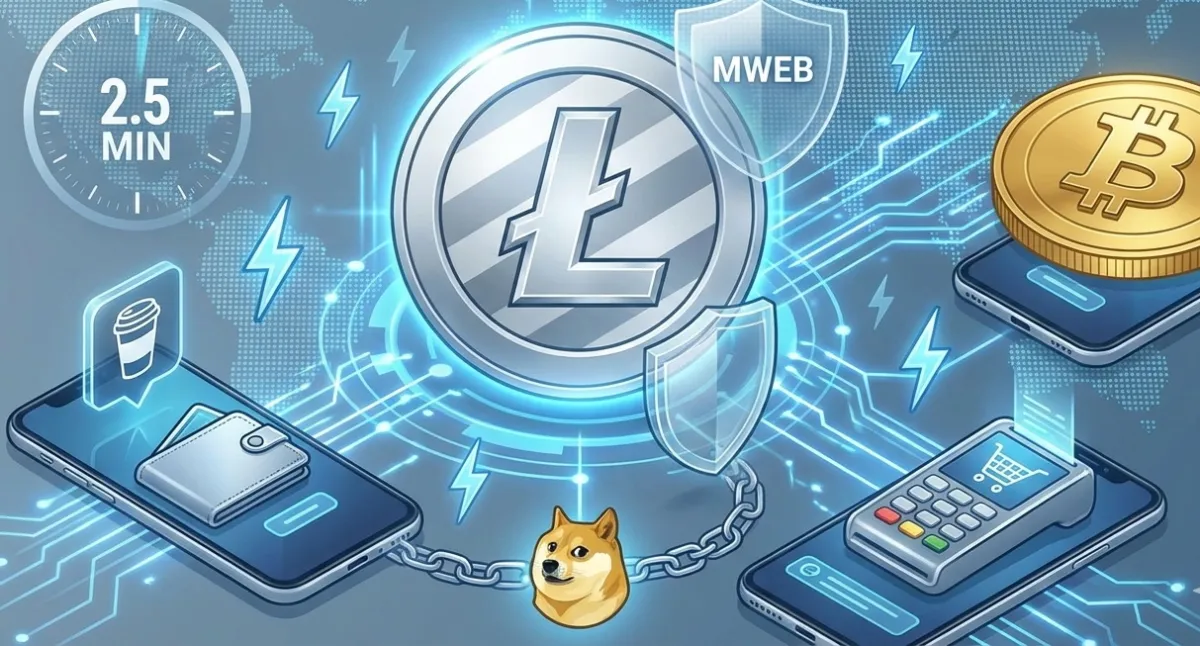
- Introduction
- History of Creation: "Bitcoin Without the Excess Weight"
- Technical Foundations: How LTC Differs from BTC
- Technological Breakthroughs: MWEB and Privacy
- Synergy with Dogecoin: Merged Mining
- Practical Application and Use
- Comparative Analysis: BTC vs LTC vs ETH vs DOGE
- Ecosystem: Where to Store and How to Buy
- Risks and Disadvantages: The Flip Side of the Coin
- Predictions and the Future (2026–2030)
- Conclusion
1. Introduction
What is Litecoin in Simple Terms? If Bitcoin is a heavy gold bar you keep in a secure safe and rarely take out, then Litecoin is the silver coin in your pocket. Imagine a currency that works as reliably as Bitcoin but moves much faster and costs mere pennies to use. It's a decentralized payment network created to become "digital cash" for everyday needs.
Status in 2026: The Old Guard Holds Its Ground By 2026, the crypto world has seen thousands of "Bitcoin killers" flare up and disappear. But Litecoin has remained in the top list for 15 years. Why? The answer lies in exceptional reliability. The Litecoin network has one of the highest uptime records in the industry — in fact, it has operated without a single failure since its launch. In a world where blockchains often "crash" under load, such stability has made LTC a favorite among conservative investors and major payment systems.
Wow-Factor: Leader in the Real Sector While other coins are discussed on Twitter, Litecoin is used. According to 2025–2026 statistics, Litecoin regularly outperforms Bitcoin and Ethereum in transaction volume on major payment processors. This means that when people actually want to buy something with crypto, not just speculate on price, they choose the "silver."
2. History of Creation: "Bitcoin Without the Excess Weight"
Charlie Lee and His Vision In 2011, Google engineer Charlie Lee (known as SatoshiLite) decided the world didn't need a competitor to Bitcoin — it needed a reliable sidekick. Charlie didn't try to reinvent the wheel; he took Bitcoin's open-source code and made key tweaks. His goal was to create a "lite version" (hence the name — Litecoin) that would be faster and more accessible for ordinary people.
What are "Code" and "Fork"? A blockchain is an open program. Any programmer can copy it and change the rules. This copying is called a fork. Imagine taking a classic bread recipe but adding baking powder to make it bake faster. That's what Charlie Lee did.
Launch in 2011: Honesty Above All Unlike many modern projects, Litecoin launched with maximum transparency.
-
No Premine: That's when creators keep millions of coins for themselves before anyone else learns about the project.
-
No ICO: That's raising money from investors in exchange for promises. Litecoin was launched so that anyone could start mining it at the same time as the creators. This earned the coin a reputation as "honest money."
Decentralization: Charlie Lee's Unique Move In 2017, an event occurred that is still discussed in the crypto world: Charlie Lee announced he had sold all his personal Litecoin holdings.
-
Why did he do it? To eliminate conflicts of interest. His tweets and actions would no longer affect his personal wealth.
-
The Result: Litecoin became one of the few projects without a "chief boss" who could manipulate the price for personal gain. The coin truly began to belong to the community, which is the highest form of decentralization.
3. Technical Foundations: How LTC Differs from BTC
If Bitcoin is a classic internal combustion engine, then Litecoin is its modified turbo version. They look similar on the outside but work on different principles.
The Scrypt Algorithm: Mining for Everyone Every cryptocurrency operates on a specific "mathematical language" — an algorithm. Bitcoin uses SHA-256, which requires enormous computing power. Litecoin, however, uses Scrypt.
What is an Algorithm in Simple Terms? It's a set of rules by which miners (participating computers in the network) solve complex problems to confirm transactions and earn rewards.
The unique feature of Scrypt is that it relies more on a computer's RAM than just processor power. Initially, this was designed so ordinary people could mine LTC on home PCs and graphics cards without buying expensive professional equipment (ASICs). This made the Litecoin network one of the most decentralized and accessible in the world.
Block Speed: The Math of Confirmations On the Bitcoin network, a new page in the "ledger" (a block) appears every 10 minutes. In Litecoin, this happens every 2.5 minutes. Why is this important? When you buy something, you need to wait for "confirmations" — the network's verification that you actually have the funds.
-
In Bitcoin, waiting for 1-3 confirmations can take 30 minutes.
-
In Litecoin, the same level of security is achieved in 7.5 minutes. For everyday purchases, this is a critical speed advantage.
Supply and Limits: Why 84 Million? The number of coins in Litecoin is limited by mathematical code. The maximum that can ever be issued is 84,000,000 LTC. Where did this number come from? It's simple: blocks in LTC appear 4 times more often than in BTC (10 / 2.5 = 4). To maintain economic balance, the creators simply multiplied 21 million (Bitcoin's limit) by 4.
Tiny Particles: Litoshis Just as a ruble (or dollar) is divided into cents, 1 LTC is divided into myriad small parts:
-
1 lites = 1/1000 LTC;
-
1 microlitecoin = 1/1,000,000 LTC;
-
1 litoshi = 0.00000001 LTC. Even if the price of one coin skyrockets, you can still pay for a matchbox using litoshis.
Halving: Inflation on a Leash To prevent coins from devaluing, the code includes a "halving." Every 4 years (or every 840,000 blocks), the reward miners receive for creating a block is cut exactly in half. This makes the issuance of new coins slower and more predictable, protecting LTC from inflation.
4. Technological Breakthroughs: MWEB and Privacy
Litecoin is often called a "testing ground" for Bitcoin. Many technologies are first implemented here and only after years of successful testing are they migrated to the BTC network.
MimbleWimble (MWEB): The Blockchain's Secret Room In 2022, Litecoin made a historic leap by implementing the MimbleWimble Extension Block (MWEB) upgrade. The name is a reference to a spell from "Harry Potter" that ties the tongue and prevents speaking.
What is MWEB and Why is it Needed? Regular blockchains are transparent: anyone can see how much money is in a wallet and where it was sent. MWEB gives users optional privacy. You can move coins into a special "extension block," where the transaction amount and addresses are hidden from prying eyes. This makes Litecoin more like physical cash: no one looks into your wallet after you've paid at a store.
SegWit and Lightning Network: Scaling the Future Litecoin was the first major cryptocurrency to implement SegWit (a technology that makes blocks more "spacious"). This paved the way for the Lightning Network — an overlay on top of the main blockchain that enables millions of transactions per second, almost for free and instantly.
OmniLite: More Than Just Money Many think Litecoin can only be used to transfer funds. But thanks to OmniLite, you can issue your own tokens (similar to shares or loyalty points) and even NFTs (digital art) on this blockchain. This transforms "digital silver" into a full-fledged platform for creating decentralized applications.
5. Synergy with Dogecoin: Merged Mining
In 2014, an event occurred that forever linked the fates of Litecoin and Dogecoin. This technology is called Merged Mining.
Technical Alliance: AuxPoW Technically, this is implemented through the Auxiliary Proof-of-Work (AuxPoW) mechanism.
What is this in Simple Terms? Imagine solving a crossword puzzle whose answers simultaneously fit into two different magazines. You spend time and effort once, but fill out both publications. In mining, this means the computational work done for the Litecoin network is also accepted as valid by the Dogecoin network.
Economic Effect: Two for the Price of One For miners, this is a "free bonus." Having equipment for mining LTC, they automatically receive DOGE coins without spending extra electricity. In 2026, this became a key survival factor for many mining pools: even if the price of one coin temporarily drops, income from the second helps maintain business profitability.
Security: Armor for Both Networks The most important benefit of this alliance is protection against a 51% attack.
What is a 51% attack? It's a situation where a single attacker gains control of more than half of the network's total mining power. In this case, they could start "rewriting" transaction history, for example, spending the same money twice.
Thanks to merged mining, an attacker would have to attack the combined power of both networks simultaneously. By 2026, Litecoin's hashrate (total computing power) has reached such heights that attempting to hack the network would cost billions of dollars, making an attack economically pointless. Thus, Litecoin not only exists on its own but also acts as a "shield" for Dogecoin.
6. Practical Application and Use
By 2026, Litecoin has finally shed its image as "just a tool for exchange speculation" and become a full-fledged unit of account.
LTC as a Means of Payment: Who's on the List? Thanks to integration with giants like BitPay and Coinbase Commerce, the number of merchants accepting LTC is in the hundreds of thousands.
-
Technology & Telecom: Microsoft (account top-ups), AT&T (bill payments).
-
E-commerce: Major platforms built on Shopify and Newegg.
-
Travel: Travala (booking over 2 million hotels), CheapAir (airline tickets).
-
Luxury & Retail: Gucci, Balenciaga, and the AMC Theatres cinema chain.
Microtransactions: Why LTC is Better Than BTC and ETH? When you want to buy a cup of coffee or a $5 service subscription, network fees become the deciding factor.
-
Fees: While on the Bitcoin network during peak times fees can be $10-20, and on Ethereum "gas" can be even more expensive, a Litecoin transfer consistently costs less than 1 cent.
-
Speed: Thanks to 2.5-minute blocks, purchase confirmation happens almost instantly at the checkout terminal level, whereas on Bitcoin, waiting can drag on for 10-30 minutes.
Cross-Border Transfers: Money Without Borders In 2026, Litecoin is the simplest way to send money to relatives or partners in another country.
-
No Intermediary Banks: The transaction goes directly from sender to receiver.
-
24/7 Operation: The network doesn't take weekends or holidays off.
-
Minimal Losses: Sending $1000 through a bank could cost you $50-100 in fees and exchange rates. With Litecoin, you send the same amount paying a fraction of a cent, and the recipient can convert it to local currency (EUR, PLN, USD) at the nearest exchange point.
7. Comparative Analysis: BTC vs LTC vs ETH vs DOGE
To finally understand Litecoin's place in the hierarchy, let's look at the hard numbers. In 2026, the market has clearly defined the roles of these assets.
Summary Table of Characteristics
| Criteria | Bitcoin (BTC) | Litecoin (LTC) | Ethereum (ETH) | Dogecoin (DOGE) |
|---|---|---|---|---|
| Speed (Block) | ~10 minutes | 2.5 minutes | ~12 seconds | ~1 minute |
| Transaction Fee | High ($2 to $50) | Ultra-low (< $0.01) | Variable (Gas) | Very low (~$0.01) |
| Privacy | Public (transparent) | Optional (MWEB) | Public | Public |
| Consensus Type | Proof-of-Work (SHA-256) | Proof-of-Work (Scrypt) | Proof-of-Stake | Proof-of-Work (Scrypt) |
| Complexity / Security | Maximum (Gold) | High (Silver) | High (Ecosystem) | Medium (Meme Asset) |
| Primary Goal | Store of value | Payments and Privacy | Smart Contracts | Micro-tipping / Hype |
Analysis: If Bitcoin wins in absolute security and Ethereum in functionality, then Litecoin has found the "sweet spot." It's faster and cheaper than Bitcoin for transfers, yet much more reliable and decentralized than many newer blockchains.
8. Ecosystem: Where to Store and How to Buy
Litecoin is one of the most accessible cryptocurrencies in the world. Over 15 years, it has been integrated into almost every significant financial instrument.
1. Types of Wallets: From "Heavy Armor" to Lightweight Apps
Choosing a wallet depends on whether you plan to hold LTC for years or spend it on coffee.
-
Litecoin Core (Desktop): This is a "full node." You download the entire blockchain to your computer.
-
Plus: Maximum security and network support.
-
Minus: Takes up a lot of disk space and takes a long time to sync.
-
Electrum-LTC (Desktop): A lightweight version. Doesn't download the whole blockchain, works fast. Ideal for those who value a balance between speed and control over their keys.
-
Nexus (Android): A modern mobile wallet focused on user-friendly interface. Allows you to send LTC in just a couple of taps, convenient for everyday use.
-
Hardware Wallets (Ledger, Trezor): The "gold standard" of security. Your private keys are stored on a physical device not connected to the internet.
-
Advice: If you have more than 10 LTC, store them here.
2. Exchange Availability: The Go-Anywhere Coin
Litecoin possesses phenomenal liquidity.
What is liquidity in simple terms?
It's the ability to quickly buy or sell an asset at market price without huge losses. The more people trade a coin, the higher its liquidity.
LTC is available on all exchanges: Binance, Coinbase, Kraken, and thousands of others. Moreover, in many trading pairs, LTC is used as an intermediary asset for transferring funds between exchanges because it's cheaper and faster than transferring BTC.
3. Institutional Recognition: Wall Street Chooses LTC
In 2026, Litecoin has definitively ceased being a "toy for geeks."
-
Litecoin ETF: Following the success of Bitcoin funds, the launch of spot Litecoin ETFs was a logical step. Now large pension funds and private investors can buy LTC through their regular bank accounts.
-
Grayscale Litecoin Trust: The world's largest institutional fund, Grayscale, has held thousands of LTC in its portfolio for years, confirming the coin's status as a long-term asset.
-
Payment Systems: Integration with PayPal, Venmo, and Mastercard allows millions of people to use LTC without even knowing the words "blockchain" or "private key."
9. Risks and Disadvantages: The Flip Side of the Coin
Even a market veteran like Litecoin has its "pitfalls." It's important for investors and users to understand the challenges the coin faces in 2026.
Competition from Stablecoins Today, many businesses choose stablecoins for settlements (e.g., USDT or USDC).
What is a stablecoin? It's a cryptocurrency whose price is pegged to the regular dollar (1 coin = $1).
Businesses find it easier to use USDT because they don't have to worry about the payment they received for goods depreciating by 5% during their lunch break. Litecoin, despite its stability relative to other altcoins, remains a volatile asset.
Regulatory Issues and MWEB The introduction of privacy features (MWEB) became a double-edged sword. On one hand, users gained anonymity. On the other, financial regulators in many countries (especially South Korea and Japan) view "hidden" transactions with extreme suspicion. This leads some major exchanges to delist LTC to avoid legal problems.
Volatility: "Silver" Against "Gold" Historically, LTC's price strongly correlates with Bitcoin. However, in recent years, a trend has emerged: when BTC rises by 10%, LTC might only rise by 5%. Investors often call this "slow growth." Furthermore, LTC lacks the powerful application ecosystem (dApps) that Ethereum or Solana have, limiting its use primarily to the payments sphere.
Security and Adoption Although the LTC network is very reliable, its hashrate (total miner power) is significantly lower than Bitcoin's. Theoretically, this makes it more vulnerable to a "51% attack," although merged mining with Dogecoin largely mitigates this risk. Also, institutional interest from banks and governments in LTC is still significantly lower than in "digital gold."
10. Predictions and the Future (2026–2030)
What awaits Litecoin at the end of the decade? Developers aren't sitting idle, and the coin has every chance to strengthen its position.
Technological Roadmap Today, the team's efforts are focused on two directions:
-
Improving MWEB: Make private transactions even simpler and integrate them into all mobile wallets.
-
Developing the Lightning Network: The goal is to make LTC payments instant and invisible to the user, like a regular card swipe at a supermarket.
Role in the Global Economy: The "Payment Layer" In the 2026–2030 scenario, Bitcoin is finally cemented as a reserve asset for states and corporations. In this system, Litecoin aims for the role of the primary payment layer. Thanks to low fees and high speed, it could become the "conveyor belt" for moving value between different blockchains and traditional banks.
Price Expectations Analysts in 2026 are divided into two camps. Conservatives believe LTC will maintain its current value, following the market. Optimists point to the halving effect and the potential inflow of funds from Litecoin ETFs. If the coin becomes a familiar instrument for pension funds, this could lead to a significant increase in its scarcity and price.
11. Conclusion
Final Summary: Who is Litecoin For?
-
For Investors: It's an excellent tool for portfolio diversification. LTC carries lower risks of total value loss compared to new "hype" coins and acts as a defensive asset in the crypto world.
-
For Users: If you need to send money abroad, pay for a VPN, buy hosting, or simply transfer funds between exchanges with minimal fee loss — LTC remains the best choice.
-
For Businesses: Despite volatility, accepting LTC opens access to a huge community of loyal users who value speed and low costs.
In the world of technology, 15 years is an eternity. The fact that Litecoin has not only survived but continues to implement innovations like MWEB speaks to its colossal strength and resilience. It's a cryptocurrency that doesn't try to be something more than it is. It simply works — fast, cheap, and reliable.
In the rapidly changing world of crypto, Litecoin remains the "digital silver" you can always rely on when "gold" becomes too heavy for everyday affairs.