

 2026-02-25 13:48:25
 873
873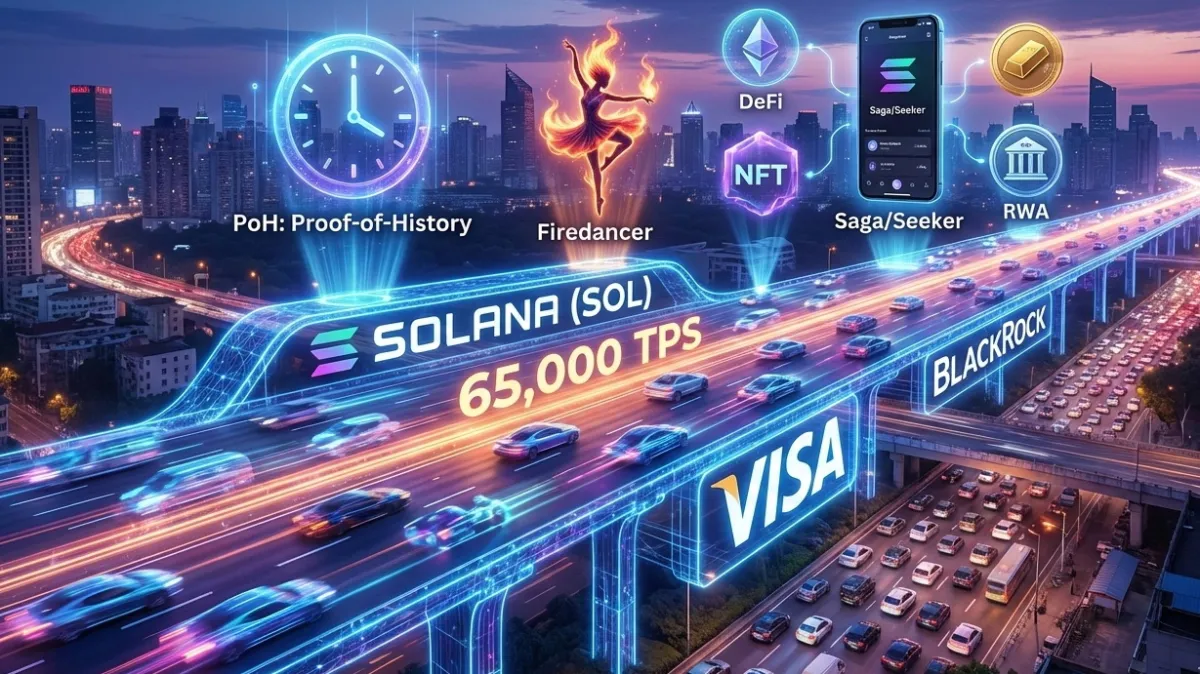
- Introduction: Why Solana is in the Spotlight in 2026
- History and Evolution: The Path to Leadership
- Technological Core: 8 Key Innovations of Solana
- Technological Breakthrough 2025–2026: A New Era of Performance
- SOL Tokenomics: The Economy of Speed
- The Solana Ecosystem in 2026: Key Growth Sectors
- Comparative Analysis: Solana vs. Competitors in 2026
- Risks, Criticism, and Challenges: The Other Side of the Coin
- Security, Storage, and Practical Use of SOL
- Community, Governance, and Resources
- Future and Prospects for Solana (2026–2030)
1. Introduction: Why Solana is in the Spotlight in 2026
What is Solana in Simple Terms?
Imagine that most blockchains (like Ethereum) are a bustling old city with narrow streets. When too many residents appear, traffic jams occur, and you have to pay a fortune to couriers to get your package delivered faster. Solana, on the other hand, is a modern 12-lane highway with an intelligent traffic management system. This infrastructure is what allows it to solve the so-called "blockchain trilemma."
The blockchain trilemma is the eternal problem: a dream network must be fast, secure, and decentralized (owned by many people, not a single company) simultaneously. Usually, you have to sacrifice one. Solana has found a way to preserve all three qualities.
The Heart of the System: Proof-of-History (PoH)
The main secret to Solana's speed is the "Proof of History" mechanism. In a typical blockchain, validators (computers verifying transactions) constantly need to "communicate" with each other to agree on the time and order of operations. This takes time.
Solana, however, created built-in "cryptographic clocks." Each transaction receives a precise timestamp even before it enters a block. Thanks to these "clocks," the network knows the chronology of events in advance and doesn't need to waste time on unnecessary "negotiations." This is what provides that incredible speed.
2026 Snapshot by the Numbers:
-
50+ million active addresses (unique crypto wallets).
-
3.5 billion transactions per month.
-
Fees: less than $0.001. You can send a million dollars or buy a cup of coffee, paying less than one-tenth of a cent for the transfer.
-
Role: It's no longer just an "Ethereum killer," but the primary base for RWA (tokenization of real-world assets, where real estate, stocks, and gold are turned into digital tokens) and DePIN (networks where people share their internet or disk resources for rewards).
Philosophy: "The Speed of Light as the Limit"
The project's founder, Anatoly Yakovenko, came from the telecommunications world (Qualcomm). His approach is simple: software shouldn't bottleneck hardware. Since modern processors and internet can work faster, the blockchain must match that speed.
2. History and Evolution: The Path to Leadership
Background and Founding Fathers
In 2017, in San Francisco, Anatoly Yakovenko (known in the community as "Toly") published a draft white paper with the idea of Proof-of-History. Together with Raj Gokal, they founded Solana Labs. From the very beginning, they built the network as an engineering system, prioritizing maximum data transmission efficiency over mere theoretical concepts.
Key Milestones: From "Teething Problems" to Global Recognition
-
2018–2020: Launch. In March 2020, the mainnet beta was released. The world saw a blockchain that was already orders of magnitude faster than its competitors.
-
2021: Explosive Growth. The year of NFT mania. Solana became the primary home for digital art due to the low cost of minting tokens. The SOL coin's price surged by 12,000%, and major funds (like a16z) invested hundreds of millions of dollars into the project.
-
2022: Year of Trials. The toughest period. The network "went down" (halted) several times due to overloads, and the collapse of the FTX exchange (a major Solana investor) crashed the coin's price nearly 10-fold. Many predicted the project's imminent death.
-
2023: Recovery. Solana proved its resilience. Instead of giving up, the community kept building. A crucial signal was Visa choosing Solana to expand its pilot projects for USDC stablecoins. It became clear: the technology was too good to disappear.
-
2024–2025: Technological Leap. The launch of Firedancer—a new, alternative "engine" for the network written by a different development team (Jump Crypto).
The launch of a second client (Firedancer) is critically important. Previously, Solana had one "driver" (code). If he fell asleep, the car stopped. Now there are two, and they back each other up. This eliminates the downtime experienced in 2022.
During this period, Solana also released its second smartphone, the Saga 2 (Seeker), making Web3 accessible right from your pocket, and experienced a "memecoin" boom, which brought millions of new retail users into the network.
-
2026: Era of Maturity. Today, Solana is a stable giant. The period of outages is a thing of the past. Now, it hosts government-issued stablecoins, major payment systems, and securities markets.
3. Technological Core: 8 Key Innovations of Solana
Engineering Marvel: Why Solana is Faster Than Any Other Blockchain
Many modern blockchains (like Ethereum) follow the path of "modularity." It's like a construction kit: one network handles security, another handles computation, and a third handles data storage. Solana, however, is a "monolith" (a single, unified block). It's a single supercomputer where all processes occur in one layer, without jumping between different networks. To prevent this "monolith" from collapsing under load, the developers implemented 8 fundamental innovations.
-
Proof of History (PoH): Built-in Time. "Cryptographic clocks" that timestamp every transaction, freeing validators from constant synchronization.
-
Tower BFT: Digital Metronome. A consensus mechanism using PoH as a common rhythm to achieve finality (transaction irreversibility) in less than 400 milliseconds.
-
Sealevel: Parallel Processing. Unlike Ethereum, where transactions are processed sequentially, Solana can process thousands of unrelated transactions simultaneously.
-
Gulf Stream: Life Without Queues. Solana has virtually no "waiting room" for transactions (mempool). Transactions are forwarded directly to upcoming validators, eliminating delays.
-
Turbine: Data Sharding. Information about a new block is broken into tiny pieces and distributed via a BitTorrent-like protocol—through neighbors, not from a single central node.
-
Cloudbreak: Memory Without Borders. A specialized database that allows simultaneous reading and writing of information about millions of accounts, preventing bottlenecks.
-
Pipelining: Hardware-Level Speed. The transaction verification process is broken into stages executed in parallel by different parts of the processor (like an assembly line).
-
Archivers: Decentralized Archive. "Archivers"—light nodes that store the blockchain's history, offloading the main validators.
4. Technological Breakthrough 2025–2026: A New Era of Performance
If the first 8 innovations are the foundation, the upgrades of the last two years have turned Solana into an "unkillable" system.
-
Firedancer: The End of the Outage Era. This is an independent client (a second "driver"), written in C++. Its main goal is to make the network fault-tolerant. In 2026, this has ensured Solana has practically 100% uptime.
-
Alpenglow Upgrade: Instant Response. Transaction finality time has been reduced to 150 ms. For the user, it feels like magic: you click "send," and the money is already on the other side of the world.
-
ACE (Async Cipher Execution): Fairness for All. This technology encrypts transactions until the moment of execution, making the queue fair and preventing bots from "jumping the line" (MEV attacks).
-
Sig: Compactness and Decentralization. A new client written in Zig, which lowers the hardware requirements for validators, allowing more people to participate in supporting the network.
5. SOL Tokenomics: The Economy of Speed
Why the SOL Token is Needed and How its "Engine" Works
If Solana is a supercomputer, the SOL token is simultaneously its fuel, electricity, and voting rights.
Functions of the SOL Token
-
Gas (Fee Payment): Every action on the network costs a tiny amount of SOL. These are still the lowest fees in the industry—often less than a penny.
-
Staking (Security): In simple terms: It's like a bank deposit that not only earns interest but also helps the bank operate. You "lock up" your coins, supporting a validator, and receive rewards in return. For the expert: The more SOL is staked, the harder and more expensive it becomes to attack the network.
-
Governance: SOL holders can vote on protocol upgrades, participating in digital democracy.
Inflation and "Burning": Balancing Value
Initially, inflation (the issuance of new coins) in Solana was high (8% annually) to attract validators. However, it decreases each year and is heading towards a target rate of 1.5% by 2026.
But there's also a counteracting process: the network burns 50% of all transaction fees.
"Burning" means coins are permanently removed from circulation, making the remaining coins rarer and potentially more valuable. In 2026, due to billions of transactions, so much SOL is being burned that it almost completely offsets the issuance of new coins, making SOL a de facto deflationary asset.
6. The Solana Ecosystem in 2026: Key Growth Sectors
From Memes to Smartphones: How Solana Took Over the Real World
In 2026, Solana is not just a technology; it's a whole universe of applications.
-
DeFi 2.0: New Finance. The main player is Jupiter, an aggregator that finds the best exchange rates for coins. Alongside it is Jito, a leader in the liquid staking space.
-
DePIN: Blockchain in the Physical World. Solana has become the primary hub for networks managing real-world infrastructure: Helium (sharing internet for rewards), Hivemapper (decentralized maps), Render (renting out GPU power).
-
RWA: Tokenizing Reality. On Solana, you can now buy tokens backed by real gold (XAUm) or US Treasury bonds (Ondo Finance). Payment giant PayPal launched its stablecoin PYUSD specifically on Solana.
-
NFT and Memecoin Culture. NFTs have evolved into event tickets and in-game items. Platforms like Pump.fun turned memecoin creation into a game, which became an ideal stress test for the network.
-
Solana Mobile: Web3 in Your Pocket. The Saga and Seeker smartphones are the first phones with blockchain built in at the hardware level. Login with a fingerprint, and the app store doesn't take a 30% commission.
7. Comparative Analysis: Solana vs. Competitors in 2026
Clash of the Titans: Why Solana is Winning the Blockchain Race
-
Solana vs. Ethereum and its L2s. Ethereum is a modular city with traffic jams and overpasses (L2s). To move money, you often need to "jump" between layers. Solana is a single metropolis where everything is in one place. Transactions on Ethereum L2s cost $0.01–$0.10. On Solana, they are $0.0001–$0.001. A 100–1000x difference makes Solana the only viable place for micropayments.
-
Solana vs. New High-Performance Blockchains (Sui, Aptos, Monad). New blockchains are also fast. However, Solana maintains its lead due to the network effect. It has "whales"—Jupiter and Jito—which are so convenient and popular that users have little reason to leave for newer, emptier networks.
8. Risks, Criticism, and Challenges: The Other Side of the Coin
Not Everything is Smooth: What Trials Lie Ahead for Solana?
-
History of Outages: Is the Network Reliable Now? The problems of 2022 are in the past. Thanks to Firedancer, the network achieved 99.99% stability in 2025–2026.
-
Centralization Concerns: A "Rich Kids' Club"? Becoming a Solana validator requires expensive hardware. This creates a risk of control by large data centers. The community is fighting this with new clients (like Sig) that lower the hardware requirements.
-
Regulatory Risks: Legal Battles. The SEC (US regulator) has been trying to classify SOL as a security. The launch of political memecoins (like $TRUMP) adds to the noise. Any sudden regulatory decision could impact the coin's availability on exchanges.
-
Competition. Technology doesn't stand still. The main challenge for Solana is to rest on its laurels and keep upgrading faster than its competitors.
9. Security, Storage, and Practical Use of SOL
Your Digital Fortress: How to Use Solana Properly in 2026
-
Network Security. Besides cryptography, the network is protected by slashing—a system of penalties for dishonest validators. If a validator cheats, a portion of their staked SOL is burned.
-
Where to Store SOL? Phantom (popular wallet), Backpack (next-gen wallet), hardware wallets (Ledger, Trezor) for large sums, Saga/Seeker (wallet built into the phone).
10. Community, Governance, and Resources
Who Actually Governs Solana?
Solana is not owned by a single person.
-
Solana Foundation: A non-profit organization in Geneva. It issues grants to developers and organizes hackathons (competitions for programmers).
-
Voting (SIMD): Any significant code changes are discussed, and then validators and coin holders vote on them.
Where to Track the Network's Pulse?
-
Solscan / SolanaFM: Block explorers. By entering your wallet address, you can see all your transactions.
-
Official Documentation: docs.solana.com — for developers.
11. Future and Prospects for Solana (2026–2030)
What's Next? The Path to a Million Transactions and Global Dominance
-
Technological Roadmap. The main goal is Firedancer v2, enabling the network to process data from all the world's stock exchanges in real-time.
-
Role in the Economy. It is expected that by 2030, the volume of tokenized real-world assets (RWA) on Solana will exceed $10 billion.
-
Analyst Predictions for 2026. Conservative: SOL establishes itself as the internet's "payment layer" in the $200–$250 range. Optimistic (Bullish): Riding the success of DePIN and smartphones, SOL could aim for $500+.
Conclusion: Solana's Place in the Modern World
If Ethereum in 2026 is "digital gold" (a reliable store of value), then Solana is "digital silver" and simultaneously high-speed internet, ideal for everyday life: purchases, transfers, gaming, and communication. It is a blockchain that has ceased to be "technology for geeks" and has become a part of our reality.