


 2026-03-25 09:13:12
 24 min
 701
701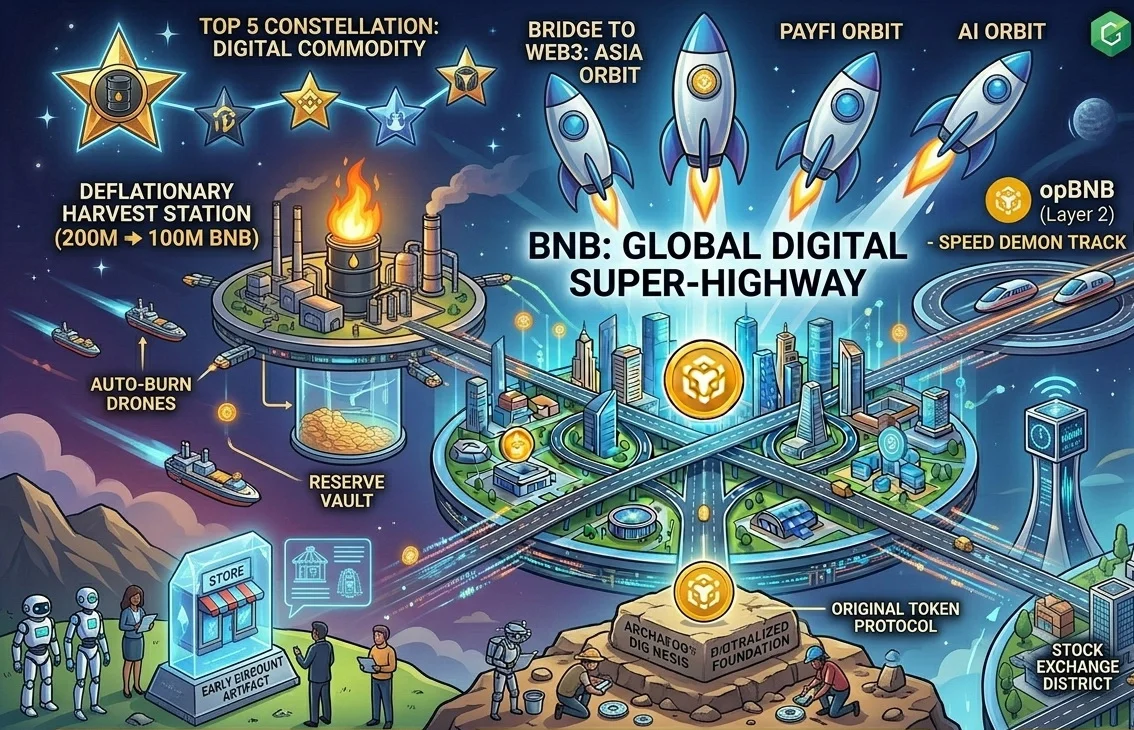
Introduction: Your Personal Gateway to the World of Tomorrow
Imagine that in 2017, you were offered the keys to a city that had not yet been built. At the time, those keys cost mere pennies and only granted a small discount at the local store. Today, that city is a vast technological metropolis, and those very keys have transformed into BNB — one of the most powerful and scarce assets on the planet.
If you still think BNB is simply the “Binance exchange coin,” you are stuck in the past. By 2026, the project’s philosophy has evolved to “Build and Build.” BNB has become the foundation of a new decentralized network that does not answer to any single individual or company. It is the “digital oil” powering next-generation banks, games, and even government services. Today, BNB is firmly entrenched in the top 5 global cryptocurrencies, recognized not merely as a speculative token but as a “digital commodity” — akin to gold or oil, but in the virtual realm.
What makes BNB so exceptional by 2026? First, it is an asset that is constantly disappearing: the system is designed so that the total number of coins in circulation shrinks over time, making each remaining one more valuable. Second, it offers incredible speed — the network processes over 20,000 transactions per second. That is faster than you can click the “send” button. Finally, it is a legitimate player that has weathered the regulatory storms of 2023–2025, emerging as a benchmark of transparency for major institutional investors.
1. The History and Evolution of BNB: From ICO to the 2026 Ecosystem
The story of BNB is a genuine thriller about how to survive in an industry where projects often burst like soap bubbles. It all began with the audacious idea to create the world’s fastest cryptocurrency exchange. To raise funds for its development, the team conducted an ICO (Initial Coin Offering) in July 2017. To put it simply, an ICO is like a “public fundraising” event for technology. You give developers money to build a system, and in return, they give you their internal “tokens.”
At that time, BNB was sold for just 15 cents and didn’t even have a home of its own — it was a temporary guest on the Ethereum network. But the project grew too quickly. By 2019, BNB had “moved” to its own blockchain, gaining independence. Then, in 2020, a true breakthrough occurred: the launch of the BNB Smart Chain (BSC). This network supported smart contracts.
A smart contract is a digital robot-lawyer. It automatically executes a deal when its conditions are met. Thanks to them, the BNB network gained its own banks and marketplaces that operate without human intervention.
By 2022, the project had fully detached itself from the exchange’s name, rebranding simply as BNB Chain. This was a manifesto: the system belongs to the community of builders of the new internet (Web3). The following years (2023–2025) were a “stress test”: court cases with US authorities, massive fines, and a change in leadership. But by 2026, the project has emerged from this storm even stronger. Today, it is implementing ultra-fast technologies and becoming the primary platform for RWA — the tokenization of real-world assets like apartments, gold, and stocks into digital codes that can be traded in seconds.
2. The Magic of Disappearing Money: Why Is BNB’s Value Increasing?
While traditional government money is constantly printed, leading to devaluation, BNB employs the opposite strategy. It follows a deflationary model. Imagine a bank that burns part of its revenue in a giant furnace every evening, so that the total amount of money in the world shrinks. In the world of BNB, this is a brilliant strategy.
Initially, 200 million BNB were created. However, the creators set a goal: to reduce the supply to just 100 million, creating scarcity. To achieve this, two “vacuums” are at work:
-
Auto-Burn: Every three months, an automated program calculates how many coins must be permanently removed from circulation. The higher the price of BNB, the fewer coins are burned, and vice versa. This creates a stable and predictable system.
-
BEP-95 (Real-time Burn): This is happening right now. Every transaction on the network burns a tiny fraction of its fee. It is as if, with every credit card payment at a store, one cent from your receipt simply evaporated from the global economy forever.
By 2026, BNB has become an “ultrasound” currency. While trillions of new dollars are being printed worldwide, the supply of BNB is only decreasing. Compared to Bitcoin, where new coins are still mined, or Ethereum, where inflation depends on network activity, BNB follows the clearest and most predictable path toward supply reduction.
Comparing the Economics of Popular Assets (2026):
|
Characteristic |
Bitcoin (BTC) |
Ethereum (ETH) |
BNB |
|---|---|---|---|
|
Max Supply |
21 million cap |
Uncapped |
100 million cap (target) |
|
Model Type |
Inflationary (currently) |
Deflationary (dependent on network load) |
Strictly Deflationary |
|
Primary Utility |
Store of value (digital gold) |
Platform for applications |
Universal tool (gas, fees, governance) |
3. Technical Architecture: How the Ecosystem’s “Engine” Works
Inside the “Engine”: The Structure of a Digital State
If you think a blockchain is just a single chain of data, then BNB Chain in 2026 is a vast metropolis with different levels of roads. To prevent the system from “lagging” when millions of people transact simultaneously, it has been divided into three parts:
-
The Foundation (BSC): This is the main layer. Here, all the primary applications reside, and your main assets are stored. This network operates on the PoSA (Proof-of-Staked Authority) mechanism. This means network security is ensured by the largest and most trusted coin holders, not by massive mining farms consuming electricity.
-
The High-Speed Expressway (opBNB): Imagine a traffic jam on the main road. You take an express lane with no speed limits, where the toll costs less than a cent. This is ideal for micro-payments and gaming. In 2026, this layer handles over 20,000 transactions per second. Any transaction is finalized in less than a second.
-
The Digital Warehouse (Greenfield): This is a decentralized storage solution. Previously, application data was stored on corporate servers (like Google or Amazon). Now, it is distributed across the BNB network. This protects your data from censorship and single points of failure.
In 2026, the network transitioned to a new technology stack called Reth. To put it simply, this is like replacing an old engine with a Formula 1 power unit. The network can now handle over 20,000 transactions per second. For comparison, this is on par with global payment systems like Visa. Furthermore, transaction finality takes less than one second.
Ahead lies the implementation of even more sophisticated privacy technologies (ZK-rollups), which will make your transactions not only fast but also highly confidential.
4. The Coin That Opens All Doors: How BNB is Used in the Real World
If BNB were an ordinary object in our world, it would be a universal key — one that fits a bank vault, the fuel tank of a race car, and even a payment terminal at a coffee shop. By 2026, its utility has far surpassed the simple hope of “when will the price go up?”
Let’s imagine a typical day for someone who decides to dive into the BNB ecosystem. It all starts with the Binance exchange itself. Here, BNB is your “golden” loyalty card. Trading assets and paying a fee? The system sees you have BNB and instantly gives you a discount. But the most exciting part begins with sections like Launchpool or Megadrop.
In simple terms: This is like a private club for shareholders. You simply hold your coins in a special “vault,” and in return, you regularly receive new, upcoming tokens from promising projects. Completely free, simply for being part of the system.
But then you decide to step into the “outside world” — the BNB Chain network itself. Here, the coin transforms into fuel. Every action, whether sending money to a friend or buying a digital artwork, requires a tiny amount of BNB for the network’s “engine” to process and record your transaction. This is called “gas.” And while gas in other networks can cost as much as premium gasoline, on BNB Chain, especially on its high-speed layer opBNB, it costs mere cents.
For those who want their money to work while they sleep, there is staking.
In simple terms: This is like putting money in an interest-bearing deposit so the bank can use it for its operations. But in 2026, things have become even more advanced with liquid staking. You “freeze” your BNB to support the network’s security, but in return, you receive a special “receipt” (e.g., slisBNB tokens). This receipt can be used in other services: you can take out loans against it or trade it. Your assets are working in two places at once — a true feat of modern financial technology.
But the most ambitious direction for 2026 is RWA (Real World Assets). Now, through the BNB network, you can gain exposure to “real” things. Major global funds have begun tokenizing stocks, gold, and even real estate right here. You can now own a tiny fraction of a prestigious office complex in Singapore, with that ownership recorded on the BNB blockchain. This makes investments previously accessible only to millionaires open to the average person with a few coins in their pocket.
5. The Storm That Didn’t Sink the Ship: Security and the Regulatory Landscape
Many ask: “Won’t this all collapse tomorrow?” BNB’s path has not been strewn with rose petals. On the contrary, the last few years resembled a tense legal thriller.
The biggest challenge came from US authorities and the SEC. For a long time, they tried to prove that BNB was an illegal “security.” This was a life-or-death battle that ended in 2025 with a landmark settlement.
What does this mean for us? The project didn’t just survive; it “matured.” Today, in many jurisdictions, BNB is officially recognized as a digital commodity — like copper or wheat. This has given large financial firms the legal right to buy the coin without fear of regulatory repercussions. In Europe, the project has fully complied with the stringent MiCA standards (a framework making the crypto market as transparent as the traditional banking sector).
But this freedom and recognition come at a price. Critics often point to centralization.
In simple terms: Blockchain was conceived as a system with no “single boss.” However, BNB Chain was long criticized for being overly dependent on the Binance exchange itself. By 2026, developers have taken a significant step to address this. The network is now managed by over 45 independent “validators” (powerful computers located around the world). This is still fewer than Bitcoin, but it is sufficient that the system cannot simply be “turned off” with a single button.
But what if the system is hacked? In the world of technology, this is a perpetual risk. Here too, BNB has its own safety net. First, there is AvengerDAO — a kind of digital vigilante force, an automated monitoring system that identifies malicious actors before they can steal funds. Second, there is the legendary SAFU fund.
In simple terms: This is a multi-billion dollar “rainy day fund.” If a technical error or hack occurs that is the platform’s fault, the exchange can compensate affected users from this fund.
Thus, by 2026, BNB has journeyed from a brash upstart to a mature, regulated, and secure financial instrument. It is no longer a “game of collectible cards,” but a serious infrastructure, its security overseen by thousands of professionals and strict governmental laws.
6. Battle of the Titans: BNB vs. Ethereum vs. Solana in 2026
When discussing the crypto market, it’s important to remember that BNB does not exist in a vacuum. It’s a constant battle for user attention and the capital of major funds. If you look at services like CoinMarketCap, you’ll see BNB firmly holds a spot in the top five global leaders. Its market capitalization — the total value of all coins in existence — runs into the tens of billions of dollars.
But the price on the screen is just the tip of the iceberg. The real activity happens “under the hood,” and can be observed in public registries like BscScan. This is a kind of open ledger where everything is visible: how many people use the network daily, and how much money they hold there. In crypto, this is called TVL (Total Value Locked) — the total amount of assets users have entrusted to the system. The higher this number, the greater the trust in the network.
To understand how BNB stacks up against its competition, let’s compare it to its two main rivals: Ethereum and Solana. By 2026, these three have carved out distinct spheres of influence.
-
Ethereum is “old money” and the global standard. It is very reliable, but even with its recent upgrades, it remains complex and can be expensive at times. If Ethereum is a massive ocean liner, its main network fees can still be “painful” (ranging from 10 cents to a couple of dollars).
-
Solana is a high-speed race car. It is incredibly fast and cheap, but it has sometimes been criticized for being young and not always stable. Its speed is impressive, but it is still fighting to achieve the status of a serious financial platform.
-
BNB Chain is the middle ground and the main hub for Asia. In 2026, thanks to the opBNB technology, the network’s throughput has surpassed 20,000 transactions per second, with transaction costs dropping to less than one cent.
What truly sets BNB apart is its economic model. Unlike Solana, which constantly “prints” new coins, causing inflation, BNB continues to burn them. This makes it a deflationary asset — the more actively people use the network, the fewer coins remain in circulation. For an investor, this sounds like music: demand grows while supply shrinks.
7. Looking Ahead: Where Is This Rocket Headed?
If 2026 is the year of recognition and legitimization, then the plans for 2027–2028 look like science fiction that is about to become reality. BNB’s developers have no intention of resting on their laurels. Their goal is to onboard half a billion users to the blockchain.
In the coming years, we will see the widespread adoption of ZK-rollups. Don’t be intimidated by the name — it’s a technology of “invisible receipts.” It allows thousands of small transactions to be bundled into one large one and verified instantly. This not only increases speed but also makes your operations more confidential and secure.
But the most ambitious vision for the future is the transformation of BNB into a kind of “Nasdaq on the blockchain.” Nasdaq is the famous American stock exchange where shares of Apple and Google are traded. The creators of BNB want their network to trade everything: from startup equity to tokenized gold bars and apartments in Dubai.
Moreover, we are entering the era of AI agents. Imagine having an intelligent digital assistant that analyzes the market, finds the best yield opportunities, and executes trades on your behalf within the BNB network, using the Greenfield storage to protect your data. This would be more than just a network for transferring money; it would be an autonomous economy where robots and humans collaborate as equals.
Globally, BNB aims to become the standard for PayFi — a new payment system where the boundary between conventional money in your wallet and digital assets finally disappears. Even now, major corporations are beginning to hold BNB in their treasuries, just as they hold Bitcoin or gold. This means regulatory risks are receding, making way for institutional adoption — when technology is trusted not only by enthusiasts but also by the serious decision-makers in the world’s largest banks.
8. How to Get Started with BNB: First Steps in the Digital Metropolis
If you’ve decided that BNB belongs in your digital wallet, you have several options. Think of it as buying foreign currency for a trip: you can go to an official bank or use a self-service terminal.
Where to Get Your Tickets to the System?
The simplest and most straightforward path for a beginner is through centralized exchanges (CEX) like Binance or Bitget.
In simple terms: These are large financial supermarkets. You register, verify your identity (like in a standard banking app), and buy BNB with your familiar money — dollars, euros, etc. This is the “main entrance” to the system, where help is available.
For those more experienced, there are decentralized exchanges (DEX), such as the legendary PancakeSwap.
In simple terms: This is like a vending machine inside the BNB network. There is no boss or cashier — you simply connect your wallet and swap one type of digital coin for another directly. It’s faster and often offers more privacy, but it requires basic knowledge of using a crypto wallet.
Where to Store Your Digital Keys?
In the world of cryptocurrency, there is a golden rule: “Not your keys, not your coins.” BNB can be stored in two main ways:
-
“Hot” wallets (Trust Wallet, MetaMask): These are applications on your smartphone or browser. They are always connected to the internet. In simple terms: This is your “everyday wallet” in your pocket. It is convenient for holding smaller amounts for daily expenses, gaming, or quick trading.
-
“Cold” wallets (Ledger, Trezor): These are physical devices, resembling a USB stick. They connect to the network only when you need to make a transaction. In simple terms: This is your “home safe.” The most secure way to store large amounts for years. Even if your computer is hacked, the thieves cannot access your funds because the “safe” is physically disconnected.
Startup Instructions: From Purchase to Profit
To not just hold the coin but to put it to work, follow these three simple steps:
-
Step 1. Buy some BNB. Start with an amount you are comfortable with — this is the price of your education.
-
Step 2. Try staking. Put your coins “to work” via BNB Chain. As we discussed, this is like a deposit: your coins are held, they help secure the network, and you earn a small reward in additional BNB.
-
Step 3. Become a citizen. Try voting on a proposal for the network’s development. This will help you feel like not just a spectator but a participant in governing a vast system.
Important Note: The crypto world in 2026 has become more civilized, but risk remains. Prices can fluctuate wildly (this is called volatility), and if you lose your wallet password (private key), there is no “customer support” to help you recover it — it simply doesn’t exist. You are your own bank, and that requires responsibility.
9. Conclusion: The Journey from a “Grain of Sand” to the Foundation of Tomorrow’s Economy
Concluding our story about BNB, it’s worth reflecting on the journey. In 2017, it was a bold experiment, a small “perk” for trading fee discounts. In 2026, it is a colossal ecosystem that has weathered lawsuits, regulatory attacks, and a change in leadership.
What does this mean for an investor and an everyday user? BNB is no longer just a tool for speculation. Today, it represents an infrastructure bet. By buying or using BNB, you are betting on a future where the internet becomes increasingly decentralized, fast, and transparent.
The unique combination of a deflationary model (where the supply of coins constantly shrinks) and immense utility (where the coin is needed everywhere — from gaming to real estate) makes BNB one of the key assets of the decade. Despite competition from Ethereum and Solana, BNB has found its niche: it has become a bridge between the world of traditional finance and the future of Web3, particularly in the rapidly growing regions of Asia.
Your Next Step: The world is changing faster than we realize. You don’t need to be a financial expert to get started. Explore the BNB Chain ecosystem, try making your first micro-transaction on opBNB, and experience the speed with which your value can move across borders.
The future has already arrived. And in this future, BNB is not just a coin; it is the energy powering a new global economy. Welcome aboard!