


 2026-04-13 12:05:37
 18 min
 947
947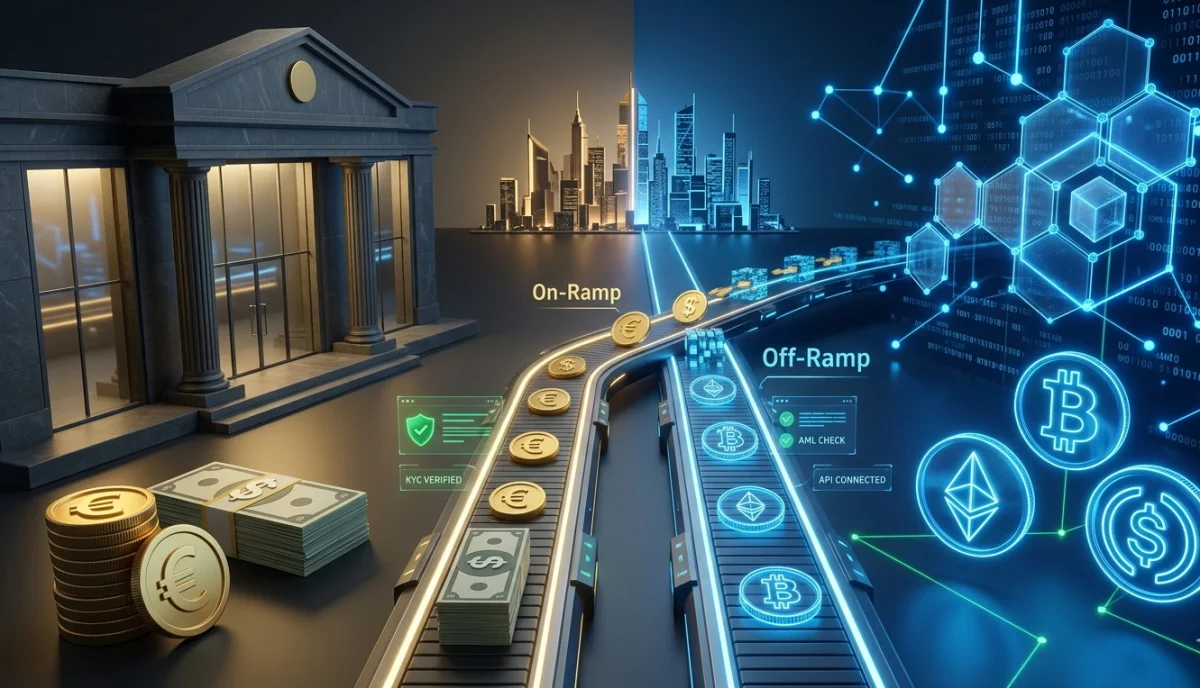
1. Introduction: the "closed island" dilemma
Imagine a hyper-modern metropolis built on an isolated island in the middle of the ocean. It features state-of-the-art architecture, autonomous transport, and an economy powered by the technologies of tomorrow. You have assets in a local bank equivalent to millions of dollars. You walk into a coastal café, order an espresso, but find yourself unable to pay.
Why? Because your assets are held in 10 BTC, while the café’s terminal only accepts traditional euros or digital state currencies. Despite its grandeur, this "technological paradise" remains isolated. To buy a cup of coffee or settle taxes in the physical world, you need a bridge, a port, or at least a customs checkpoint.
In the crypto industry, on-ramp and off-ramp services serve as these vital communication lines. Without them, the entire crypto market, despite its trillion-dollar capitalization, would remain a useless "sandbox" for a narrow circle of enthusiasts.
By 2026, the border between traditional finance (fiat) and the world of blockchain has become nearly transparent, yet it still exists. The implementation of MiCA in Europe and the development of instant payment systems have turned the currency exchange process into a strategic element of any fintech business. This guide explores the mechanics of these "gateways" and how to navigate them in the new regulatory era.
2. What Are On-Ramp and Off-Ramp? Understanding the gateways.
In the simplest terms, these services are the "entrance" and "exit" doors of the crypto ecosystem. They determine how easily capital can flow between the old and new financial worlds.
2.1. The entry point: on-ramp
An on-ramp is any service that allows you to exchange fiat currency (USD, EUR, GBP) for digital assets. When you use your credit card to buy Ethereum on an exchange or use a specialized widget in your non-custodial wallet, you are utilizing an on-ramp. For businesses, this is the primary tool for user acquisition, as it lowers the barrier to entry for newcomers.
2.2. The exit strategy: off-ramp
An off-ramp is the reverse process—converting cryptocurrency back into fiat and moving it to a bank account, card, or cash. This is the most critical part of the cycle for investors and workers receiving salaries in crypto. If you cannot "off-ramp" your profit, your digital wealth remains theoretical.
3. The On-Ramp Mechanics: from fiat to digital assets
The modern on-ramp experience has evolved from a week-long waiting game to a process that takes mere seconds. However, under the hood, it involves complex orchestration between banks, liquidity providers, and compliance engines.
3.1. How the on-ramp works: a step-by-step breakdown
1. Verification (KYC): In 2026, anonymous entry is virtually non-existent. You start by providing ID and often a liveness check (biometrics). 2. Method Selection: You choose between a card payment (instant but higher fee), a bank transfer (SEPA/FedNow), or even Apple Pay/Google Pay. 3. Liquidity Matching: The gateway finds the best current rate across multiple exchanges to ensure you get the most "coin" for your "cash." 4. Asset Delivery: Once the fiat is confirmed, the service sends the crypto to your designated wallet address.
4. The Off-Ramp Journey: returning to traditional finance
The "exit" is often more scrutinized than the "entry." Banks are traditionally cautious about incoming funds from crypto sources, making the choice of a professional off-ramp provider crucial for avoiding account freezes.
4.1. Key payout methods in 2026
- Instant SEPA/Fast Payments: The gold standard in Europe and the US, allowing funds to reach your bank account in under 30 seconds.
- Visa/Mastercard OCT: Direct "Original Credit Transactions" that send funds straight to your plastic card.
- Business Payouts: Automated systems for companies to pay vendors or employees in fiat while holding crypto on their balance sheets.
5. P2P vs. Direct Gateways? Choosing the optimal path.
There are two primary ways to move assets: through a decentralized Peer-to-Peer (P2P) market or through a centralized professional gateway (B2B/B2C).
| Feature | P2P Platforms | Direct Gateways |
|---|---|---|
| Speed | Moderate (depends on the counterparty) | Near-Instant |
| Safety | Risk of "dirty" funds and fraud | Institutional-grade security |
| Fees | Often lower or hidden in the rate | Transparent percentage |
| Compliance | Minimum/Variable | Full MiCA/AML compliance |
6. Professional Checklist: how to vet a provider.
For a business or a high-capacity investor, the choice of a gateway is a matter of security and efficiency. Do not be misled by "0% fee" advertisements; the real cost is often hidden elsewhere.
- Liquidity Depth: Can the provider handle a $100k trade without moving the market price by 2%? This is known as slippage control.
- Success Rate: How often do bank transfers fail? Top-tier gateways maintain a >95% success rate for card transactions through optimized merchant routing.
- Global Coverage: Does the service support local payment methods like PIX in Brazil, SEPA in the EU, or ACH in the US? Regional diversity is key for global scale.
7. The 2026 Horizon: the era of "invisible" finance
The trend is clear: the most successful financial tools are the ones you don't even notice. In the coming years, we expect "invisible" on-ramps where a user pays with a bank card, and the merchant receives crypto instantly, with the conversion happening entirely in the background.
7.1. AI-driven liquidity and "Smart Gateways"
By 2026, gateways aren't just pipes; they are intelligent brokers. AI algorithms now predict market volatility in real-time to offer guaranteed rates for larger time windows. This eliminates the "price anxiety" users feel when they see a quote change every 10 seconds. Smart gateways also route transactions through the most cost-efficient banking corridors, automatically switching between SEPA, SWIFT, or local networks to save on fees.
7.2. Integration with CBDCs
As Central Bank Digital Currencies (CBDCs) like the Digital Euro or Digital Pound become mainstream, the very concept of an "off-ramp" will change. We are moving toward a Unified Ledger system where swapping a government-backed digital coin for a stablecoin or Bitcoin happens instantly within the same wallet infrastructure, effectively merging the two "islands" of finance into a single continent.
8. Strategic Risks: what the brochures don't mention
Even the most sophisticated bridge has friction points. If you are moving significant capital, you must look beyond the user interface and understand the underlying operational risks.
8.1. The "Source of Funds" bottleneck
The biggest risk in an off-ramp journey isn't the gateway failing—it's your traditional bank blocking the incoming transfer. Banks often trigger automated "Anti-Money Laundering" (AML) flags for large crypto-related deposits. To mitigate this, professional investors use gateways that provide clear, chain-analysis-backed documentation that proves the "cleanliness" of the funds, making the bank's compliance check a formality rather than a roadblock.
8.2. Counterparty and Settlement risk
While instant transfers are becoming the norm, larger volumes may still face settlement delays. If you send $1M in BTC to an off-ramp provider and the market crashes while the funds are in transit, who bears the risk? Professional B2B gateways offer "Price Lock" features that guarantee your fiat payout the moment the transaction is initiated on-chain, protecting you from 15-minute volatility swings.
9. Regulatory Evolution: the impact of MiCA and global compliance
Regulation is no longer a "hurdle"—it is the foundation of trust. The Markets in Crypto-Assets (MiCA) regulation in Europe has set a global standard that others are rushing to follow.
9.1. Consumer protection and asset segregation
Under MiCA, on-ramp and off-ramp providers are treated as Crypto-Asset Service Providers (CASPs). This means they must strictly segregate client funds from corporate funds. In the event of a provider's bankruptcy, your fiat and digital assets remain yours and cannot be used to pay off creditors. This institutional-grade security is what finally allows pension funds and large corporations to enter the space with confidence.
9.2. The "Travel Rule" and transaction transparency
The era of anonymous gateways is officially over. The "Travel Rule" requires providers to share sender and receiver information for transactions above a certain threshold. While this may frustrate privacy advocates, it is the price of admission for crypto to be accepted as a legitimate part of the global financial system. It turns crypto from a "gray zone" into a transparent, auditable asset class.
10. Final Verdict: the bridge to a unified economy
The evolution of on-ramp and off-ramp services marks the transition of cryptocurrency from a speculative asset to a functional tool of the global economy. By choosing the right "bridges," businesses and individuals can move capital with the speed of the internet and the security of a traditional bank.
We are witnessing the death of the "closed island" model. As these gateways become faster, cheaper, and more regulated, the distinction between a "crypto wallet" and a "bank account" will continue to fade. Those who master these institutional tools today will be the architects of the seamless financial landscape of tomorrow.