

 2026-04-15 10:50:09
 19 min
 977
977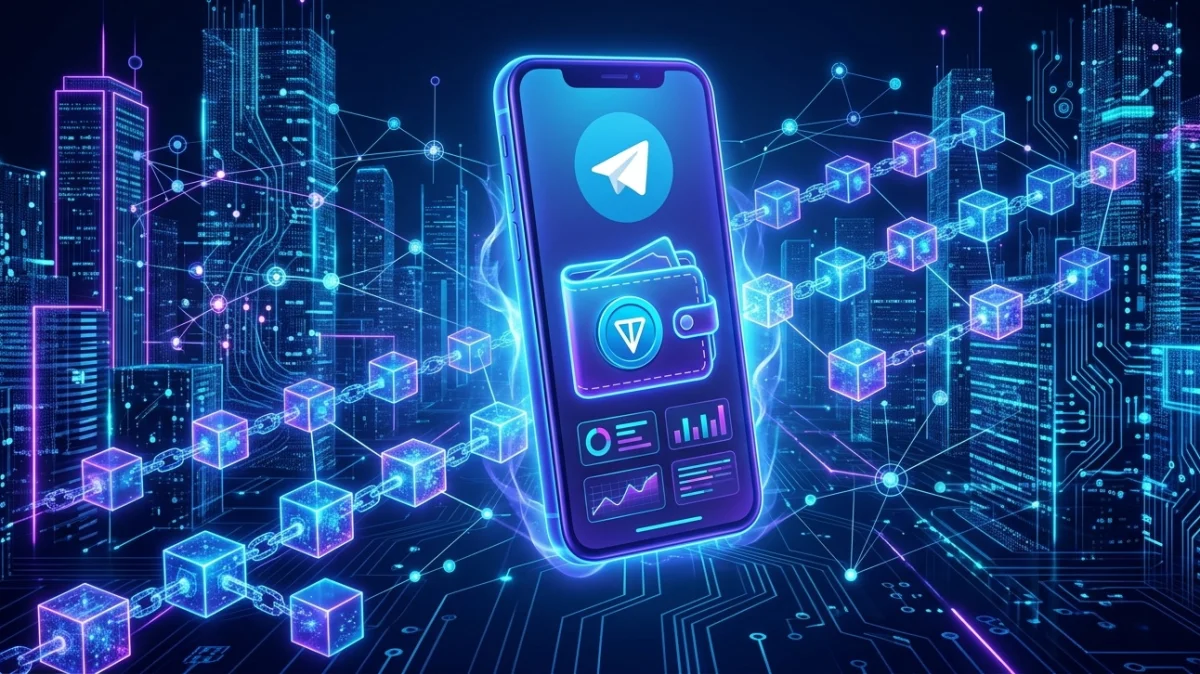
1. Introduction: The Toncoin Phenomenon
Have you ever wondered why the world’s most privacy-focused messenger suddenly became a powerhouse for decentralized finance? It started quietly: a wallet bot here, a "stars" system there, and suddenly, the ability to pay for Telegram Premium with a digital asset. At the heart of this transformation lies Toncoin (TON).
Toncoin is not just another speculative asset. It is the functional "fuel" for an entire digital civilization built into an app used by nearly a billion people. Think of a hyper-modern metropolis—one with its own stores, transit systems, and services. To navigate this city, you need a universal "Digital Pass." In the Telegram ecosystem, Toncoin is that pass.
It is crucial to distinguish the two: Toncoin is the currency, while The Open Network (TON) is the blockchain—the underlying tracks and regulations. To use the analogy of a high-speed rail: the blockchain is the infrastructure, and Toncoin is the ticket that allows the train to move. TON’s appeal is defined by three pillars: Simplicity, Scalability, and Utility. By removing the friction of complex seed phrases and clunky interfaces, TON has brought blockchain directly to the user’s contact list.
2. What Is Toncoin? A Fundamental Breakdown
Toncoin (TON) is the native utility token of The Open Network. Just as Ether powers Ethereum, Toncoin is the lifeblood of its network. It isn't just a medium of exchange; it is the electricity that powers every smart contract and transaction on the chain.
Key Roles of Toncoin in the Ecosystem:
- Network Fees (Gas): Transaction costs on TON are among the lowest in the industry, typically costing fractions of a cent. This makes it viable for micro-transactions and high-frequency use.
- Staking and Security: Holders can "stake" their coins to support network validators. In exchange for securing the network, stakers receive an annual yield (historically between 4–8%). Currently, roughly 23% of the total supply is locked in staking.
- Decentralized Governance: Through the TON VOTE platform, the community decides the future of the network. The protocol follows a democratic model where your "voice" is proportional to your holdings.
- In-App Utility: From purchasing Telegram usernames on Fragment to paying for ad campaigns in the Telegram Ad Platform, Toncoin provides a seamless circular economy.
The Independence Factor: It is a common misconception that Telegram "owns" TON. While they are strategic partners, TON is a decentralized project. After the legal hurdles of 2020, the project transitioned into the hands of the TON Foundation—a global community of developers. Telegram provides the massive user base; TON provides the decentralized engine.
3. History: From "Gram" to a Resurrected Giant
Phase I: The $1.7 Billion Vision (2018–2019). The Durov brothers launched the Telegram Open Network and held a massive private ICO. The original token, "Gram," was designed to be the first truly mass-market cryptocurrency, integrated directly into the messenger's core.
Phase II: The Legal Setback (2020). The US SEC intervened, labeling Gram an unregistered security. The resulting court injunction forced Telegram to step back. Pavel Durov officially announced the project's cessation, returning $1.2 billion to investors and paying substantial fines.
Phase III: The Community Resurrection (2020–2021). Telegram made the code open-source, allowing the community to take the torch. The "TON Foundation" was formed, the network was rebranded as The Open Network, and Toncoin was born. Most of the supply (98.5%) was distributed through "Giver" smart contracts, ensuring a fair, mining-based launch for the new iteration.
Phase IV: The Super-App Era (2022–2026). Telegram officially reintegrated the technology as its primary Web3 partner. This era saw the launch of the @wallet bot, TON Space (a non-custodial wallet), and the explosion of the "Mini App" ecosystem, bringing the network to its current billion-user potential.
4. TON Technology: Solving the Scalability Trilemma
How does TON handle millions of users when other networks struggle with congestion? The answer lies in its unique, multi-layered architecture.
Infinite Sharding: Most blockchains function like a single grocery store with one cashier. When more customers arrive, the line grows. TON uses "Dynamic Sharding," meaning the network can split into multiple "workchains" and "shardchains" automatically. If the load increases, new "cashiers" appear. If the load drops, they merge. This allows for a theoretical capacity of millions of transactions per second (TPS).
Hypercube Routing: Communication between these shards is nearly instantaneous. TON achieves "finality" (the point where a transaction cannot be reversed) in under 5 seconds. Compare this to minutes on Ethereum or an hour on Bitcoin.
BFT Consensus (Byzantine Fault Tolerance): TON uses a Proof-of-Stake model where validators are held accountable by strict mathematical rules. If a validator attempts to cheat, their collateral is "slashed" (burned). This ensures that even if some participants are malicious, the network remains honest and operational.
5. Tokenomics: A Balanced Economic Engine
Supply Dynamics: The initial supply was set at 5 billion TON. Unlike many "VC-backed" coins where large portions are reserved for insiders, 98.5% of TON was mined by the public during its initial launch phase. This makes it one of the most equitably distributed major blockchains in existence.
Inflation vs. Deflation: New coins are created at a rate of approximately 87,000 TON per day to reward validators. This results in a very low annual inflation rate of ~0.4%. For perspective, this is significantly lower than Solana (~6%) or even Bitcoin’s current pre-halving rates.
The Burning Mechanism: To counter inflation, a portion of every transaction fee (roughly 4,000+ TON daily) is permanently burned. As network utility increases—through more games, ads, and transfers—the burning rate could eventually exceed the emission rate, making TON a deflationary asset.
6. Telegram Integration: The Ultimate Competitive Edge
TON’s "Killer Feature" isn't just its speed—it is its distribution. No other blockchain is natively embedded into a platform with 950+ million active users.
- The Wallet Ecosystem: Users can choose between @wallet (a simple, custodial service) and TON Space (a non-custodial wallet). This allows beginners to start easily while giving power users full control over their private keys.
- Ad Revenue Sharing: Telegram has democratized its ad platform. Advertisers pay in TON, and channel owners receive 50% of that revenue. This creates a massive, organic demand for the token that isn't dependent on market speculation.
- Digital Assets on Fragment: Fragment.com has revolutionized digital ownership. You can buy premium usernames, anonymous numbers, and NFTs using TON, with some usernames selling for over a million dollars.
- Mini-Apps and GameFi: Telegram has become a gaming console. Viral hits like Notcoin and Catizen have onboarded millions of non-crypto users by making "mining" as simple as tapping a screen.
7. The Booming Ecosystem: DeFi and Stablecoins
The TON ecosystem is rapidly maturing beyond just "simple transfers." It is now a full-fledged financial hub.
The Rise of DeFi: With over 650 decentralized apps (dApps), the Total Value Locked (TVL) has seen exponential growth. Platforms like STON.fi and DeDust offer deep liquidity for traders, while EVAA Protocol allows users to lend and borrow assets without middle-men.
Native USDT: The launch of USDT on the TON blockchain in 2024 was a watershed moment. Users can now send stable digital dollars as easily as a text message, with fees that are negligible compared to Ethereum or even Tron. This eliminates the "fear of volatility" for everyday payments.
8. Risks and Market Considerations
No investment is without risk. To provide a balanced view, we must look at the challenges TON faces:
- Whale Concentration: Approximately 68% of the supply is held by large-scale holders. While many of these are validators or long-term foundations, a coordinated sell-off by "whales" could lead to significant price volatility.
- Regulatory Scrutiny: Despite its decentralized nature, the shadow of the 2020 SEC case remains. New global frameworks like Europe's MiCA could present hurdles for centralized service providers within the ecosystem.
- Telegram Dependency: While the blockchain is independent, its growth is currently tethered to Telegram's success. Any geopolitical or technical threat to the messenger would indirectly affect TON's adoption rate.
9. Storage, Security, and Acquisition
Where to Buy: TON is listed on nearly every major global exchange (Binance, OKX, Bybit). For a more integrated experience, users can buy directly through the Telegram P2P market or DEXs like STON.fi.
The Golden Rule of Storage: "Not your keys, not your coins."
- For Convenience: Use the built-in @wallet.
- For Daily Use: Use Tonkeeper or TON Space.
- For Security: Use a hardware wallet like Ledger for large holdings.
Security Protocols: Always enable 2FA, never share your 24-word seed phrase, and beware of "phishing" bots that mimic official Telegram services. In the decentralized world, you are your own bank.
10. Conclusion: The Road Ahead
Toncoin represents a massive experiment in Invisible Tech. It aims to put blockchain into the pockets of a billion people without forcing them to learn a single technical term. Its unique position as the native currency of the Telegram "Super-App" gives it a moat that other blockchains simply cannot replicate.
Whether you are an investor looking for a high-growth asset, a developer seeking a massive audience, or an everyday user wanting to send money across borders instantly, Toncoin provides a viable, high-speed solution. The coming years will determine if TON can fully convert its billion-strong "passive" audience into an "active" Web3 economy. So far, the momentum is undeniable.